
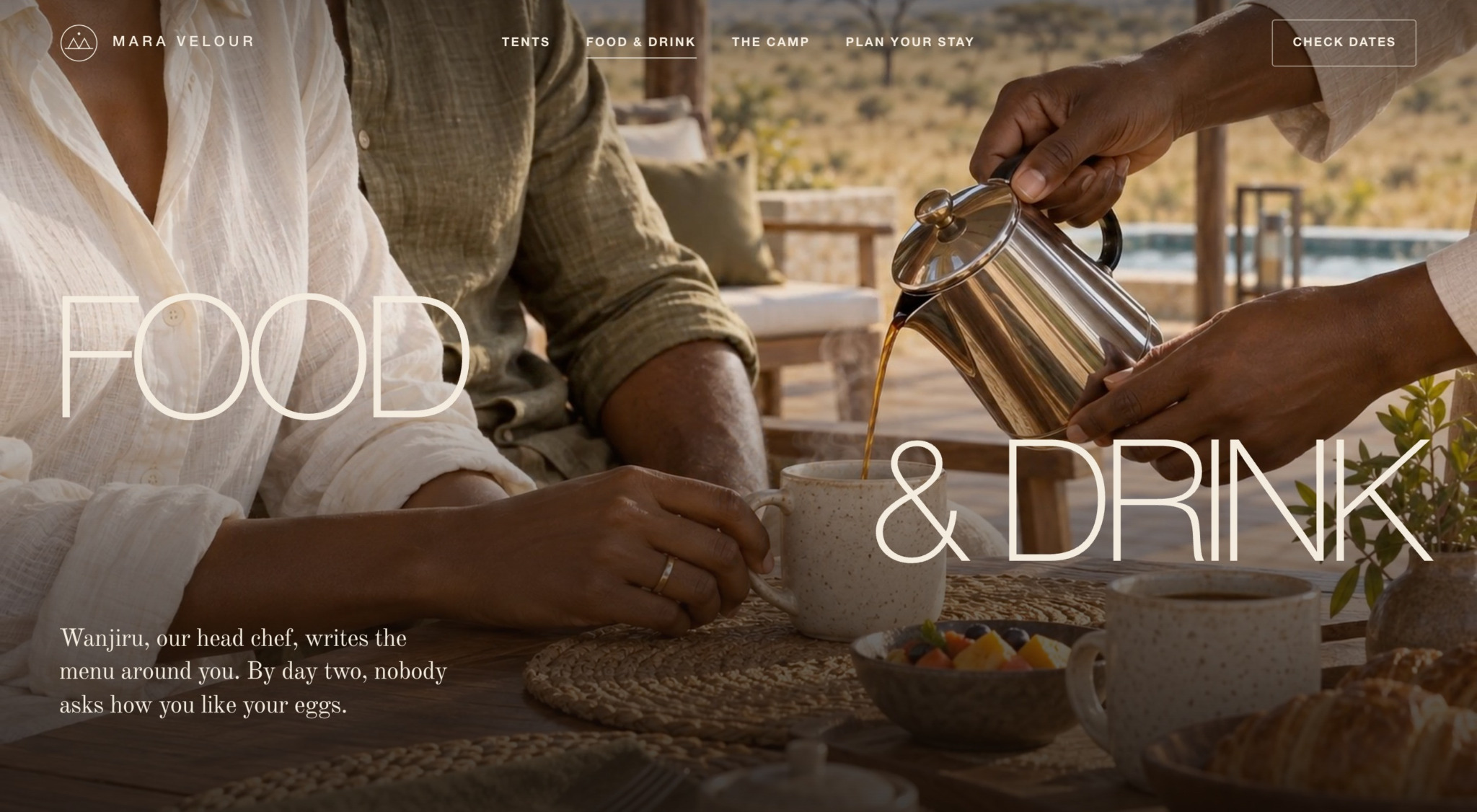
Good safari camp website design starts with one couple. They are planning an anniversary safari, and they read your camp’s website to find out if the money buys what they hope for. That means quiet sightings, a tent with no other tent close by, a guide who knows them and the right month to travel. When the page answers all of that, they send you dates instead of questions.
I have spent more than 10 years in branding, design and marketing, including work for lodges and safari companies. When I plan a safari camp website, I hold every page to one standard, set by what a guest needs to know before booking. The strongest camps in Kenya’s Maasai Mara, run by andBeyond, Asilia and Angama, each meet parts of it very well. I link to their pages below, so you can open them and compare.
Mara Velour is a 12-tent camp brand and five-page website I created and directed, and I show how it answers each point. If you run or plan a luxury safari lodge in Kenya or Tanzania, the checklist at the end lets you test your own website.
Start with what your guest is afraid of
Before I plan a single page, I write down who the guest is. For Mara Velour, that was a couple aged 35 to 65, or a family, from the UK, the US or Europe. Many book through a travel agent. For many, it is one big trip, such as an anniversary.
Then I write down what they are afraid of. They fear paying a top rate and then sitting in a line of 20 vehicles round one lion. The camp feels like a hotel. They get the flights or the season wrong.
Each fear becomes a section of the website, and each section heading gives the answer.
The big groups know these fears too. Asilia’s page for Naboisho Camp says the national reserve is busy from June to September, with the migration and the visitors it brings. In the conservancy next door, the page says, the game viewing is still “without the crowds”.
Your guests may be different. Write your own list first, because it decides the order of your pages.
Give each tent its own fact list
A guest should be able to compare your tents without writing to you. My standard is the same short set of facts for every tent type: who it sleeps, who it suits and what is inside.
andBeyond meets this well. Its accommodation page for Kichwa Tembo Tented Camp lists 34 canvas tents in three types. Each type has the same list: how many guests it sleeps, who it is “Ideal for”, the room size and how many of that tent there are. The family tent, for example, sleeps two adults and two children. Under the tents, a list says what the rate includes. The camp’s own menu includes a brochure to download, the kind of file an agent can send to a client.
On Mara Velour, the tents page has three types: six classic, four twin and two family tents. Each type has a fact list for the bed, the deck, the bathroom and what is inside, and a line on who it suits. I added one more detail that turns a fact into a reason to act. Under the family tent, a caption tells parents that with only two family tents, school holiday dates go first.

Put the practical answers near the top
The fear of getting the season or the flights wrong is answered with plain facts: the months for each season and the times for each flight.
Asilia’s page for Naboisho Camp does this well. It opens with a paragraph about the camp, then three short facts in capitals. The closest airstrip is a 45-minute drive away. Children aged 5 and older can stay. The camp is open all year. Further down, each season has its months, its temperatures and its rainfall, and the rates are listed per person per night. It also says where the tourism fees go: to run the conservancy and to pay leases to the Maasai who own the land.
On Mara Velour, Plan Your Stay has two seasons by month, July to October for the migration and November to June for the green season. “Getting here from Nairobi” shows the flight from Wilson Airport on a drawn map. The route draws itself when the map comes into view, and a small plane moves along it as you scroll. The copy says that if you cannot reach Wilson Airport by 9.30 am, you should spend the night before in Nairobi, and it gives the luggage limit for light aircraft: soft bags of up to 15 kg each.
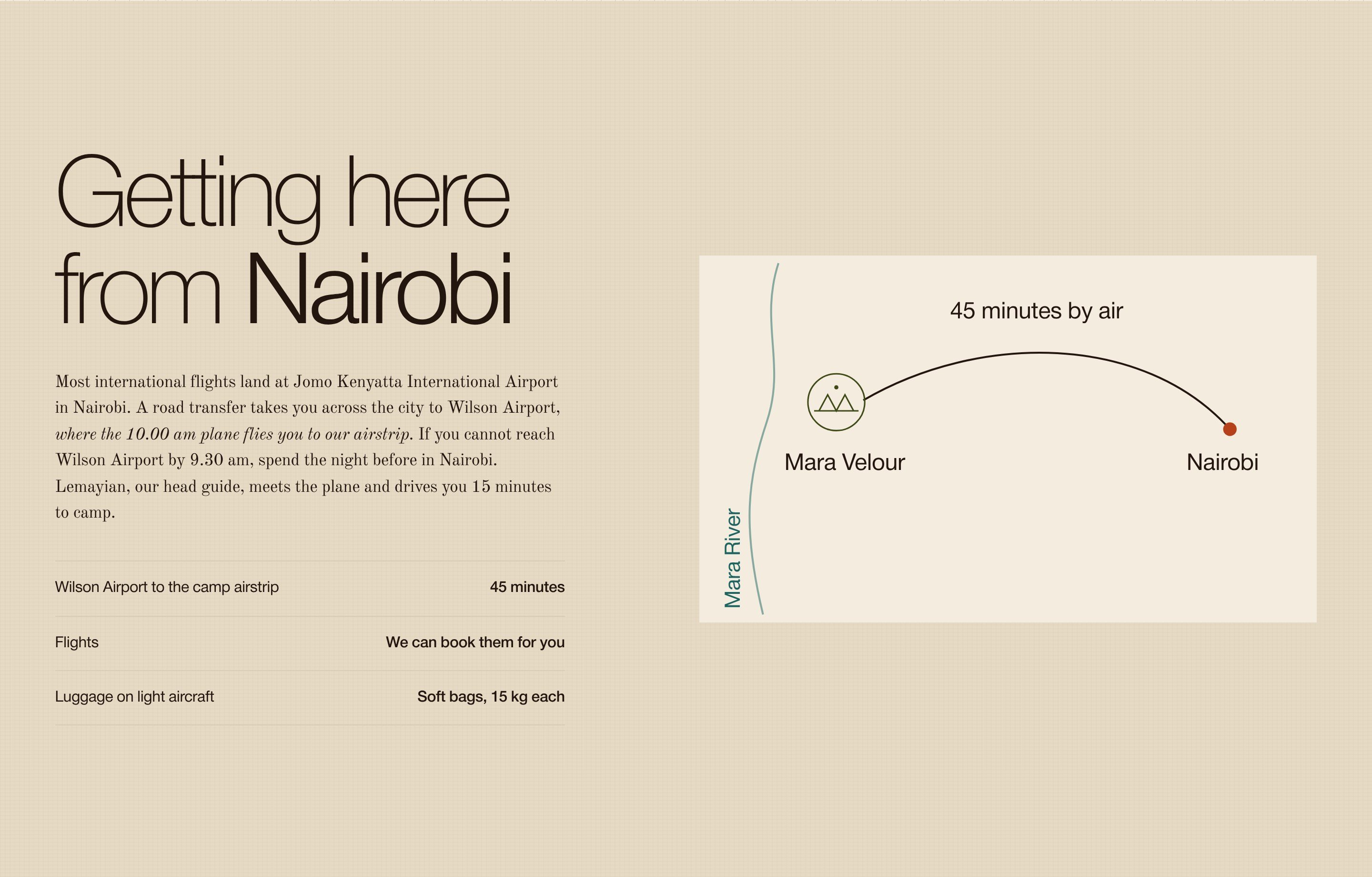
Below the map, the questions guests ask before booking are answered on the page: rates, what is included, children, safety at night, health, packing and entry to Kenya.
Give every number its reason
A number is easier to remember when the reason for it sits in the same sentence. Angama’s page for Angama Mara is the clearest example I know. The lodge is “a short 45-minute flight” from Nairobi. It has two separate camps, each with 15 tented suites. It sits about 1,000 feet above the plains.
Other camps do the same. andBeyond’s page for Tengile River Lodge mentions strict vehicle limits at sightings and gives the size of the land, 10,500 hectares, inside a sentence. ol Donyo Lodge says in one line that its land, the Mbirikani Ranch, is “owned by 4,000 Maasai”.
On Mara Velour, four numbers are set large in the section called “No more than five vehicles”, each with a sentence that says what it means for the guest:
- 12 tents, so the team knows your name by your first lunch.
- 5 vehicles, the most allowed at a sighting, yours included.
- 350 acres of open land for each guest bed, so a sighting rarely means a queue.
- 45 minutes by light aircraft from Nairobi, so you are on a drive the same afternoon.

Your guide switches off the engine, and you stay as long as the animal does.
Show the stay day by day
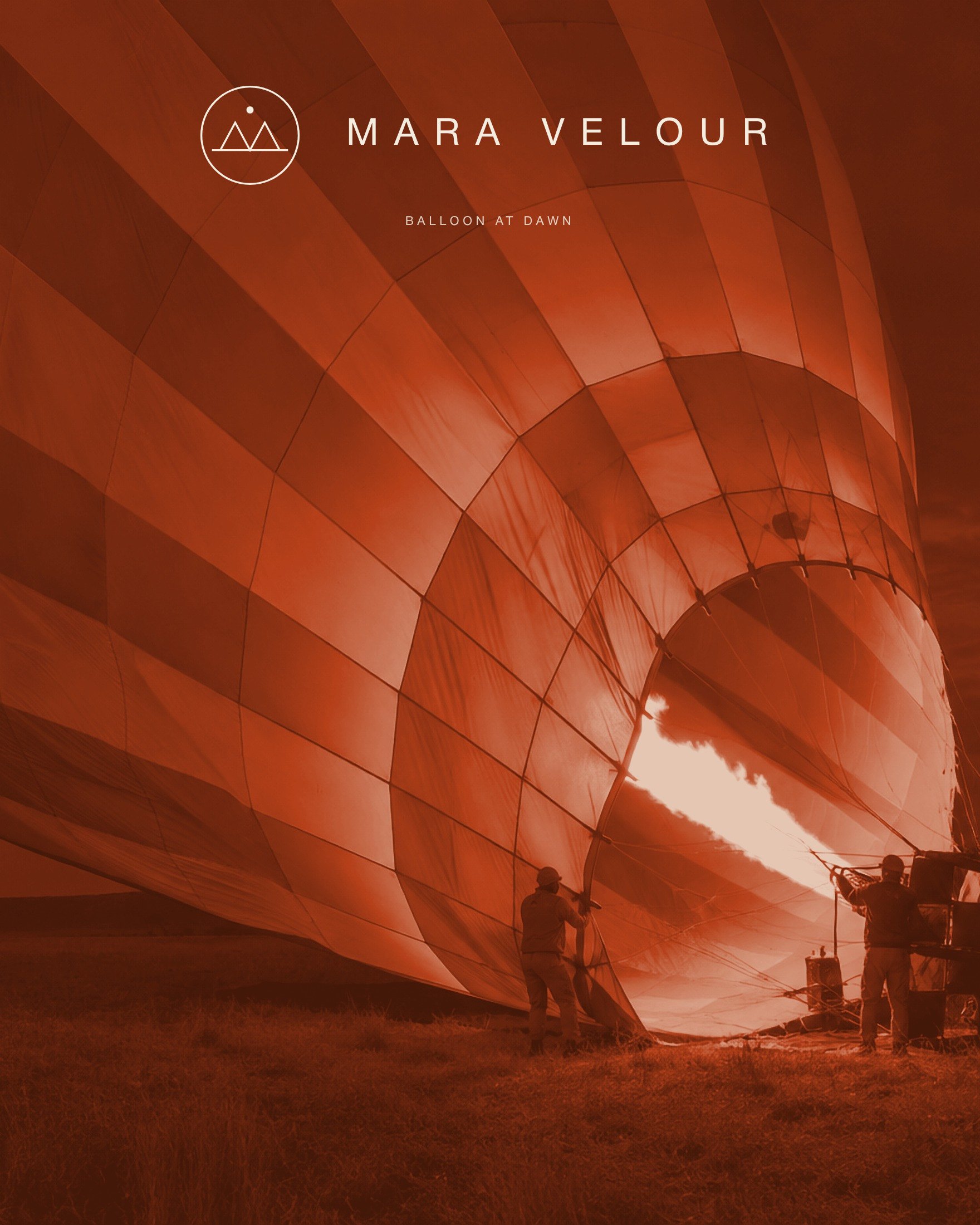
Angama’s section called “The Perfect Stay” answers a question guests ask, how many days they should stay. On Mara Velour I wanted the guest to see the days themselves, with the times. “A five-night stay” on the home page shows five moments, each with a time or a name. The first drive leaves camp at 4.00 pm. The balloon lifts off at about 6.15 am, and the card says the flight costs extra, so it is never a surprise on the bill. Kipeen, a Maasai ranger, shows you the night’s tracks. A night drive goes out after dinner with a red spotlight.
Give your team names and jobs
A guest who knows the guide’s name before the trip already knows one person at the camp. That answers the fear that a camp will feel like a hotel.
Asilia gives its people a section of their own on its home page, called “Our People”, and each guest review there carries a first name. andBeyond’s Kichwa Tembo page describes its service as “the guide who remembers your favourite sundowner, the chef who adapts the menu to your tastes”. On Angama’s journal, “Leaving Out The Dull Parts”, members of the team write posts, among them Japheth Supeyo, who worked in Angama’s photographic studio.
On Mara Velour, “Who looks after you” shows four people, each with a portrait, a first name, a job and one fact. Lemayian, the head guide, grew up 20 minutes from camp and started as a spotter in 2012. Wanjiru, the head chef, writes the menu each morning. Achieng, the camp manager, answers your first email. Their names come back on the pages where guests meet them. Lemayian meets the plane, and Wanjiru teaches the cooking class at 2.30 pm.

Say what happens after the enquiry
The big groups have reservation teams who answer each enquiry. The buttons on Asilia’s Naboisho page say “Check Availability” and “Enquire”. The rates section on andBeyond’s Kichwa Tembo page ends with “Enquire with your Travel Specialist”, and Angama’s page asks guests to contact a travel planner. andBeyond’s home page also tells you about the people who reply: “Our Travel Specialists never send a guest anywhere they haven’t been themselves”.
On a smaller camp’s website, the page itself has to tell the guest what happens next. My standard is to say who replies, how soon and what the guest commits to.
Mara Velour has one button label on every page, “Check dates”, always in the same burnt orange, a colour kept for the places where a guest can act. The enquiry sets out the plan in three steps. You send your dates. Within 24 hours, Achieng emails you which tents are open and a first plan for your stay. The tents are held only when the guest likes the plan and pays a deposit. Under the form, one line says that sending your dates costs nothing and books nothing. Another says travel agents can send dates for their clients too.

Photos, colours and the captions
A camp sells what a guest will see, so I build the look from the photographs. For Mara Velour, I sampled every colour from the camp photos and gave each one a job. Linen is the main background. Acacia green is used for the footer and the large blocks of colour. Dusk blue is for the nights. Ember, the burnt orange, is kept for booking.
Headings are set in Helvetica Neue in a thin weight, with one phrase heavier. The body text is Old Standard TT, a typeface in the style of nineteenth-century printed books. The photos keep to golden hour, firelight and blue dusk, with no flat midday light.

A caption can carry far more than a description of the photo, and the best safari journals already use it that way. The Londolozi blog names the leopard and the place, such as the Nhlanguleni Female at a cluster of boulders. In “A Beading Safari”, an Angama journal post, the captions name the women, such as Mamma Elizabeth.
On Mara Velour, each caption has a small gold pin and one or two short lines, and adds a time, a name or a practical fact:
- Beside the couple on their deck: “Your deck faces the open plains, with no fence in between. Keep the binoculars by your chair.”
- Under the elephants: “These elephants stayed in view for 20 minutes, and no other vehicle came.”
- By the pool: “The pool is not heated. By 2.00 pm on a hot day, you will be glad.”
The copy keeps to plain facts about what the guest will see and do.
A safari camp website design checklist
If you run a camp or lodge in Kenya or Tanzania, these are the points I would check first on your website:
- Your first screen says where you are, and what makes your game drives different, in one line.
- Each tent or room type has its own fact list and a line on who it suits.
- Each season has its months, and the getting-here section has times and luggage limits.
- Your numbers sit in sentences that give the reason for them.
- Your stay is shown day by day, with times and any extra costs.
- Your captions add a fact the photo cannot show.
- Your guides and managers have names, jobs and photos.
- The enquiry says who replies and how soon.
- Travel agents can find a fact sheet without emailing you.
See the full Mara Velour case study, or read what the best safari lodge websites get right, what a luxury lodge website needs and web design in Arusha.
Short answers for camps and lodges
What should the first screen of a safari camp website show?
Your strongest photo, the camp’s name, one line that says where you are and what makes your game drives different, and a way to check dates. On Mara Velour, that line reads “Twelve tents on Maasai land in Kenya’s northern Mara, where you watch lions without a crowd”, with a booking bar for dates and guests under it.
Should a lodge show its rates on its website?
Well-known camps do it both ways. Asilia’s Naboisho Camp page lists a rate per person per night for each season. Angama’s Mara page says its rates are all-inclusive and asks guests to contact a travel planner. If you cannot publish full rates, a “from” price per person per night, with the months it covers, saves guests and agents an email.
Do travel agents need their own page?
Agents need facts they can copy into a proposal: tent types, the child policy, what is included and photos. andBeyond’s home page links to a Travel Trade Portal and an image library, and Asilia’s menu has a Trade link. A smaller camp can put the same facts on a short page or in a fact sheet to download. On Mara Velour, the enquiry form tells agents they can send dates for their clients.
How long does a safari camp website take to design and build?
A camp website at this level is usually a custom website, quoted after a short brief. A website of up to 5 pages from my packages takes about a week. Your start date is confirmed once your notes, logo, photos and the deposit are in.
Can my team update the website after it goes live?
Yes. I build client websites in WordPress, set up in your name. At handover you get notes and a short video that show how to make the everyday edits yourself.

