
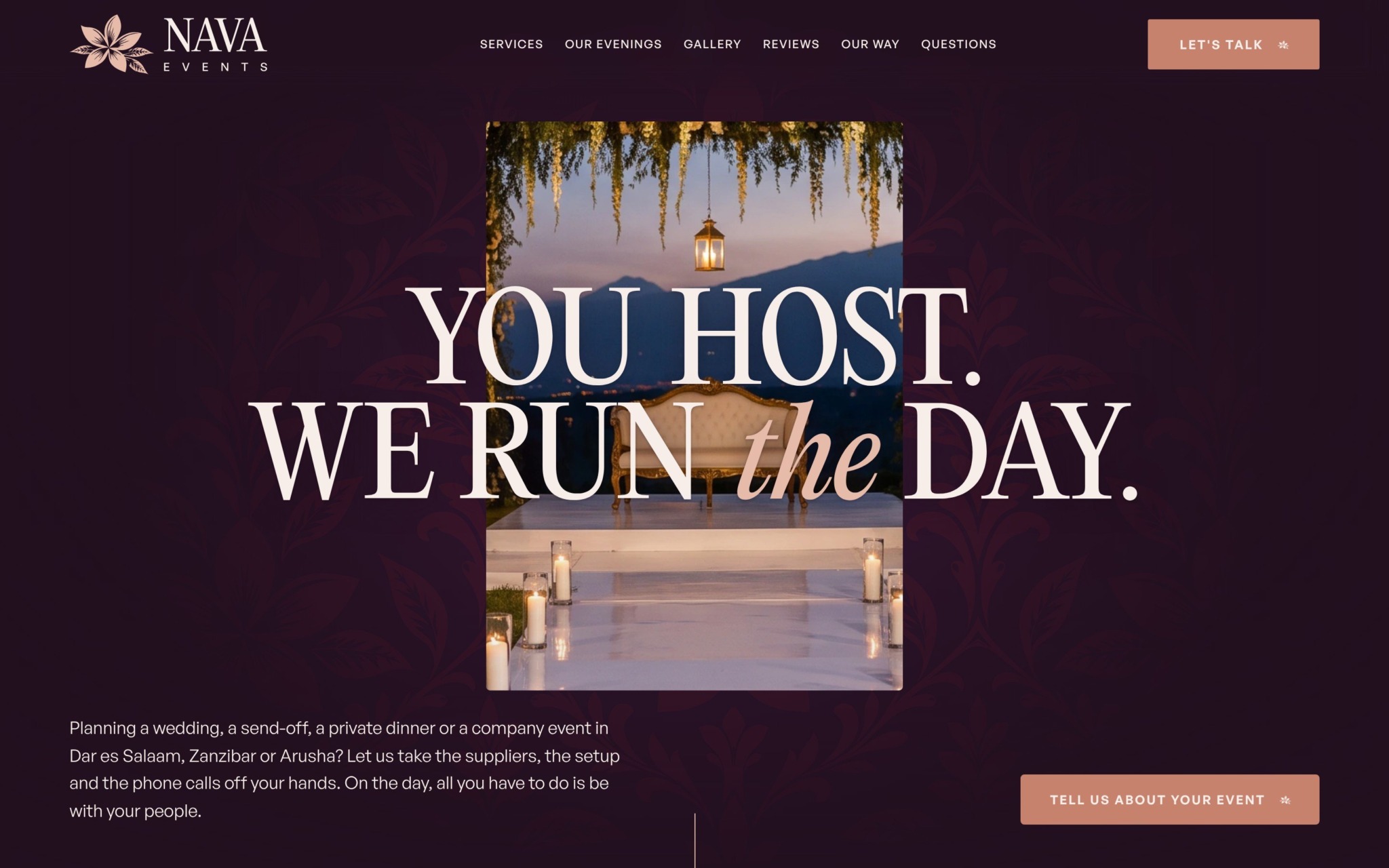
A couple in Dar es Salaam has a date, a venue they nearly like and a guest list that grows every weekend. Her mother has views on the flowers, and his family wants a send-off as well. Before they send anyone a WhatsApp, they open three or four wedding planner websites and try to answer one question. Can we trust these people with a day we only get once?
Beautiful photos are a start. Before they write, couples, families and companies in Dar es Salaam, Zanzibar and Arusha also look for whole evenings, how the day is run, who does what and what happens when something goes wrong. When your website shows them that, the enquiry arrives with a date, a venue and a guest count, ready for a quote.
Below are the seven things the best wedding and event planner websites in the world show before a couple enquires. Each section also shows how I put that thing on the page for NAVA Events, an event planning brand and one-page website I created for Dar es Salaam, Zanzibar and Arusha.
Show whole evenings with their story
A gallery of tables shows your taste. A couple also wants to know you have run an evening like theirs, with a similar number of guests, in a similar kind of place. Give each event a short story: where it was, how many came and what you took care of.
Some of the best-known planners state their experience in plain numbers. Jove Meyer’s website says he has produced “more than 200 events” as a wedding planner in New York. Mindy Weiss describes a “30+ year career” and a “team of twelve”. Some planners keep their work private, and Lisa Vorce Co describes its celebrations as “held in confidence”. If you cannot show a client’s photos, you can still describe the evening with the place, the guest count and the work you handled.
On the NAVA Events website, the section “Three evenings we planned” tells three stories, each beside its own photograph. The coastal dinner in Zanzibar begins: “Forty guests, one long table by the water, and a whole schedule built backwards from sunset.” The story of a wedding weekend in Dar es Salaam counts three days, four locations and eleven suppliers. Each story ends with a line headed What we handled, such as styling direction, supplier timing, tablescape and guest flow.

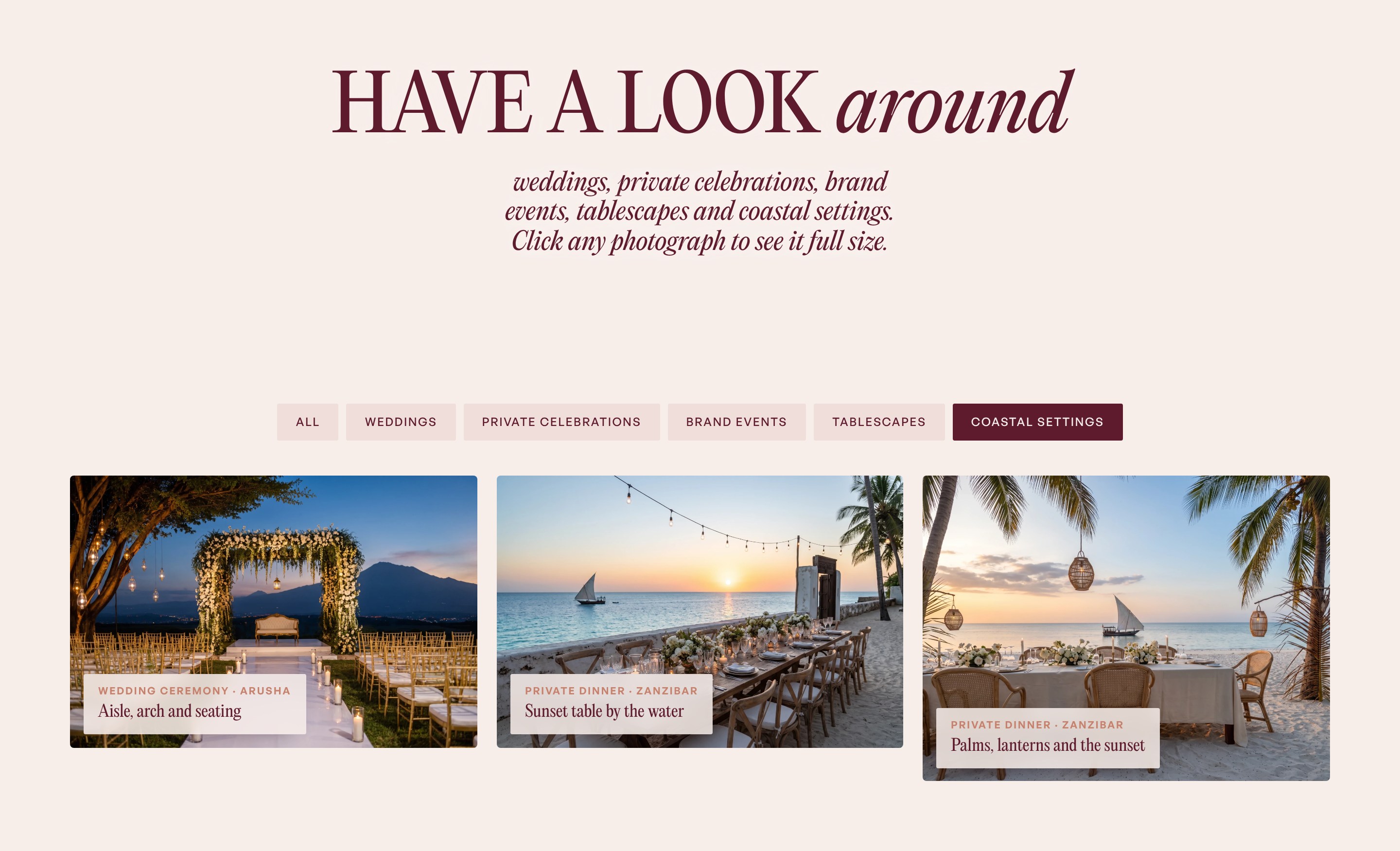
Further down, the gallery captions each photograph with what it shows, the kind of event and the town, such as “Sunset table by the water”, a private dinner in Zanzibar. Filter buttons let a couple see only weddings, only private celebrations, only brand events or only coastal settings.
Put real times on the page
A couple who enquires wants to know that the day will run on time. Show what happens and when, from the first supplier arriving to the last one leaving. Times on a page are easier to believe than a promise to be organised.
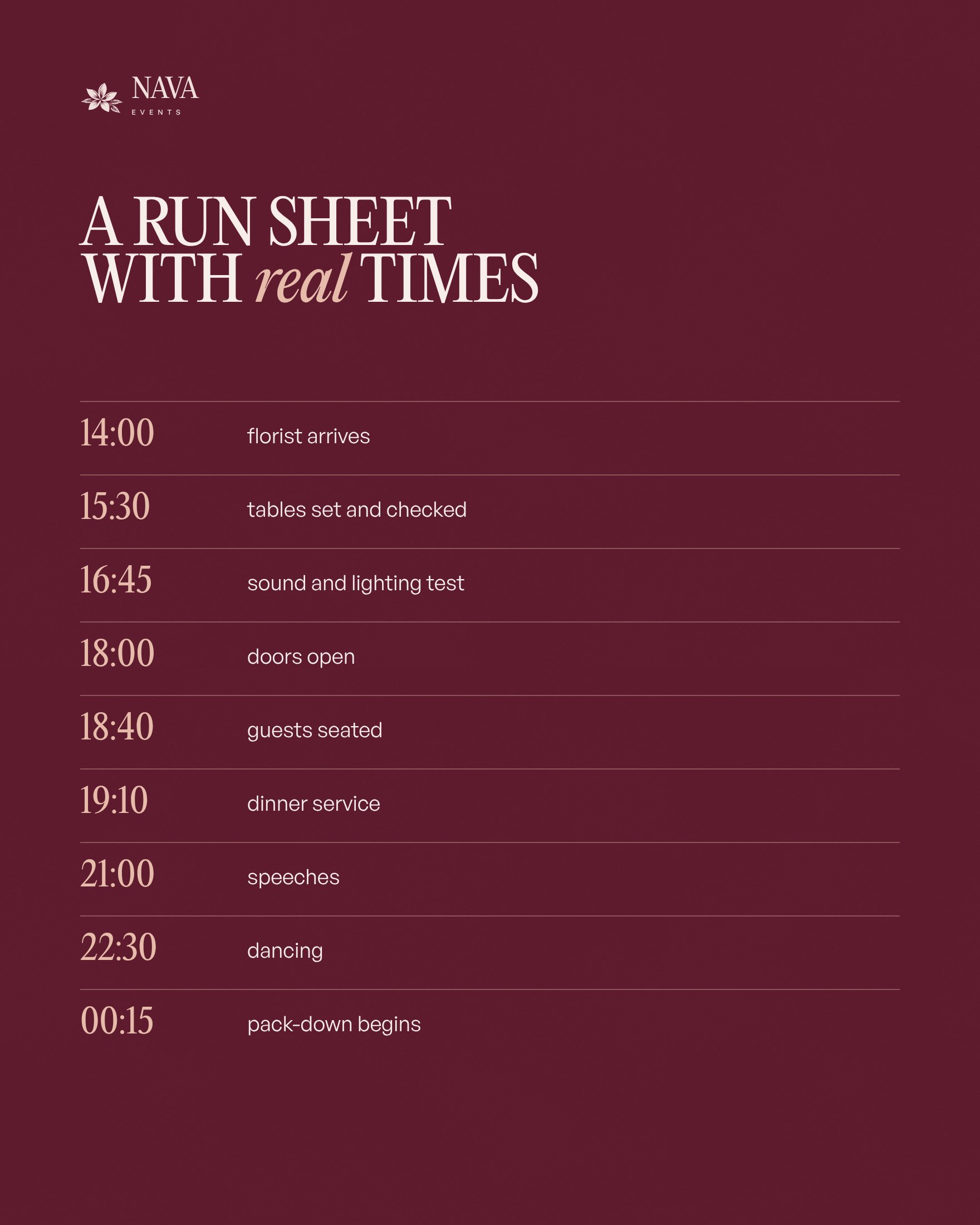
NAVA’s run sheet sits under the services as a line of times: 14:00 florist arrives, 15:30 tables set and checked, 16:45 sound and lighting test, 18:00 doors open, 18:40 guests seated, 19:10 dinner service, 21:00 speeches, 22:30 dancing and 00:15 pack-down begins. The service above it is called “A run sheet with real times”.
Dates for planning belong on the page too. NAVA’s questions section suggests three to six months for a wedding or a large event. For Zanzibar, The Mora Zanzibar tells couples that the “dry season from June to October is perfect for outdoor weddings”, and that couples must be in the country for “at least 48 hours before the ceremony”. Facts like these save a couple an email and show that you know the place.
Say who does what on the day
Hosts worry about being the person every supplier calls on the day. Your website should say who takes those calls instead.
Sarah Haywood, a wedding planning firm based in London, describes its work as “allowing our clients to be entirely present while we manage the complexity behind the scenes.” Easton Events says: “Every Easton couple is paired with a hand-selected team of photographers, filmmakers, florists, and creative partners.”
NAVA’s services section lists six jobs, each with a number and one or two sentences: your suppliers, setup and styling, a run sheet with real times, your venue and layout, your family, hosts and team, and the day itself. The first says it plainly: “We become the one person your florist, caterer, decorator, sound and lighting teams, photographer and venue all report to.” The last says the team is on site from the start, and you host.

Name the worries before they ask
A couple may never write their worries in the enquiry, and they still have them. When the website names those worries first, the reader can see you have run days like theirs before.
One NAVA section is headed “We know what keeps you up at night”, followed by “and it is rarely the flowers.” It then lists five questions a host is already asking:
- Who tells the florist she now needs to set up at two instead of four?
- Who checks the sound before the first guest walks in?
- Who answers your mother’s questions while you are getting dressed?
- Who makes sure the speeches do not swallow the dinner?
- Who is still there at midnight when everything needs packing away?
Each question comes from the host’s side of the day. A client quote on Mindy Weiss’s homepage points the same way, calling her “our therapist, peace keeper, cheerleader, stress reliever”. The quote is about how the planner made the client feel, and the flowers come later.

Show how you work, step by step
Couples want to know what happens after the first message, and how much of the work stays with them.
Several well-known planners tell clients they take on a limited number of events. Sarah Haywood says: “We commit to a limited number of clients each year to guarantee every project receives the highest level of care and attention.” Easton Events says it plans “a select number of destination weddings each year”. Both lines tell a couple they will not be one name in a long list.
NAVA’s section “This is how we do things” sets out five steps, from your first message to the last supplier leaving: you tell us about the day, we talk it through with you, we put the plan together, we manage everyone for you, and you arrive and host. Step three promises one working plan “with names and times next to each item”.
Answer the budget and family questions
The two questions couples find hardest to ask are about money and family. Answer both on the page, so nobody has to ask.
NAVA’s answer on budget reads: “Tell us the range you are comfortable with. If the list and the number do not match, we will say so before any work starts, and we will show you what does fit.” On a family that is very involved: “It is the most common situation we walk into, and we are good at it.” Another answer says where NAVA works: “Dar es Salaam, Zanzibar and Arusha are home for us”.
Prices help too. Zuri Zanzibar, a resort, shows prices inside its wedding planner form, such as a symbolic wedding at US$2,200 and dinner upgrades priced per person. A planner can do the same with budget ranges. I cover this in should you put prices on your website.

Ask for the date, venue and guests
A planner cannot check a date or give a price without four facts: the kind of event, the date, the place and the number of guests. Ask for those in the form, and say what happens after the form is sent.
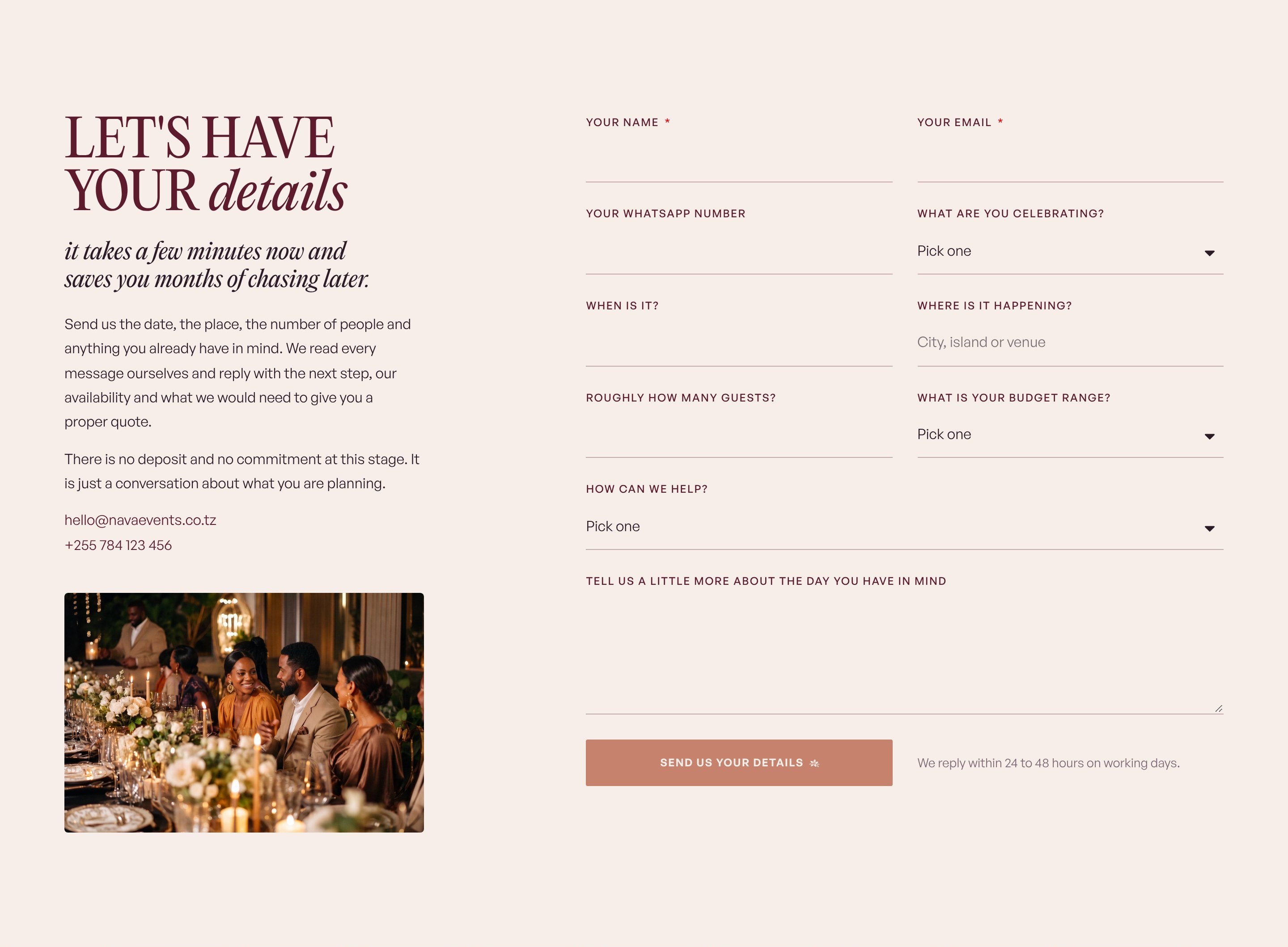
Zuri Zanzibar’s form asks couples to “select the date of your wedding & enter the number of guests” before it shows the rest of the options. NAVA’s form, “Let’s have your details”, asks what you are celebrating, when, where, roughly how many guests, a budget range in Tanzanian shillings and how NAVA can help, with a WhatsApp number beside the email. The line above it says: “We read every message ourselves and reply with the next step, our availability and what we would need to give you a proper quote.” Under the button: “We reply within 24 to 48 hours on working days.”
Then test the form on a phone, on mobile data. When I reworked the NAVA website, I took out a loading screen and a smooth-scrolling effect, so the first screen shows sooner on a phone with a weak signal. There is more on forms and replies in why event enquiries go quiet.
Check your wedding planner website line by line
- The first screen says what you plan, where you work and what the host gets.
- Each past event has a place, a guest count and a list of what you handled.
- Gallery captions name the kind of event and the town.
- A sample run sheet shows real times.
- Your services say who deals with suppliers, the venue and the family.
- The worries hosts have are named, in their own words.
- Your steps run from the first message to the pack-down.
- Budget, family and travel questions are answered on the page.
- The form asks for the event, the date, the venue and the guest numbers, and says when you reply.
- WhatsApp sits beside email, and the page loads quickly on a phone.
The whole NAVA page is at events.theascend.net, and the NAVA Events case study shows how it was planned.
Short answers for planners
What should a wedding planner website include?
Stories of past events with the place, the guest count and what you handled, a sample run sheet with real times, a clear list of your services and the steps from first message to pack-down. Add answers on budget, family and travel, and an enquiry form that asks for the event, the date, the venue and the number of guests.
Should a wedding planner show prices on their website?
A starting price or budget ranges help couples decide whether to enquire. Zuri Zanzibar shows prices inside its wedding form, and NAVA Events asks for a budget range in Tanzanian shillings. If every event is different, say what a typical range covers.
What should a wedding enquiry form ask?
The kind of event, the date, the place, roughly how many guests, a budget range and the help the couple wants, plus a WhatsApp number. Say under the form who replies and how soon.
Can an event planner use a one-page website?
Yes. The NAVA Events website is one page, from the promise at the top to the enquiry form. A one-page website works well when the sections follow the questions a couple asks, in order, and the menu jumps to each one.
How long does a planner website take to build?
A website of up to 5 pages usually takes about a week, up to 10 pages one to two weeks, and up to 20 pages about two weeks. The time starts once your notes, logo, photos and the deposit are in.
