You have photographs of tables you are proud of, and a couple who cried when they walked into the room. Then an enquiry arrives that says “how much for decor for 200?”, you spend an evening on a careful reply, and nothing comes back.
If that line went to several planners at once, your reply was up against figures sent within the hour, and it had to guess the date, the place and the kind of help they wanted. The fix starts on the website, before anybody writes. I will show it with NAVA Events, an events website I designed for weddings, family celebrations and company evenings.
Why does a careful reply get no answer?
Because it arrives before the trust. A figure sent to a host who has never seen how you work gets compared on the number alone. Aisle Planner, which makes software for planners, lists sending a price the moment an enquiry lands among the biggest pricing mistakes, and notes that couples are less likely to disappear when they feel they can talk to you.
The website can do much of that work first. When the page has already shown a host how you run a day, who carries the worry and what you need to quote, the enquiry that arrives is longer, and your reply can answer it.
What should the page show before anyone writes?
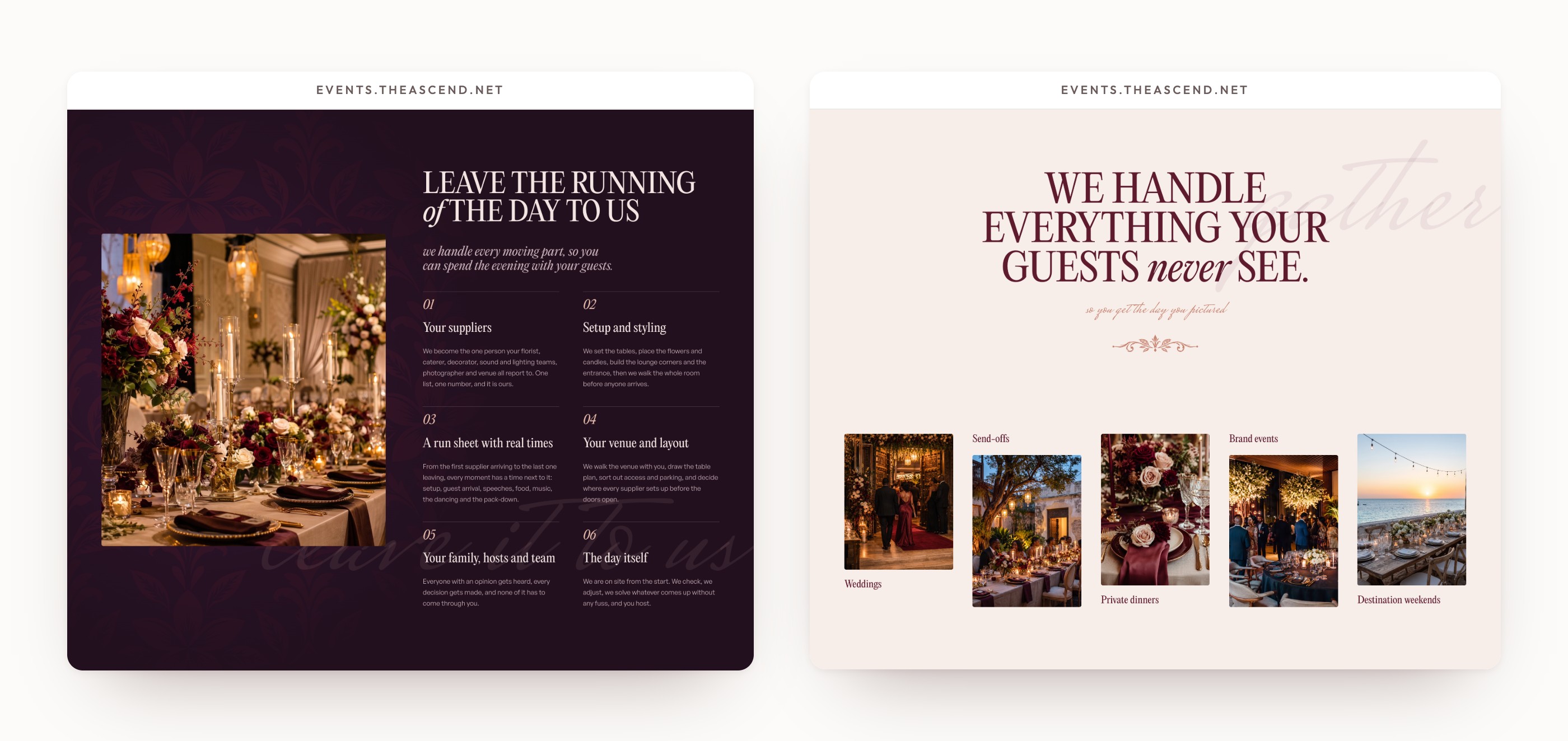
The worry first, then the work. NAVA’s page names what the host is living with before it sells anything: “We know what keeps you up at night, and it is rarely the flowers.” The questions they lie awake with follow, such as “Who tells the florist she now needs to set up at two instead of four?”
Then what NAVA takes on, each in a sentence: the suppliers, setup and styling, the run sheet, the venue and layout, the family and the day itself. The run sheet appears with its times, florist at 14:00, doors at 18:00, guests seated at 18:40 and pack-down at 00:15, so a host sees the hours they will never have to think about. Three evenings follow, each with a list of what was handled behind the scenes, and then the reviews.
Each of those answers saves the host an email and you a reply.
What should an event inquiry form ask?
What you need to check the date and quote, in the order you check it. After name, email and a WhatsApp number, NAVA’s form asks:
- What are you celebrating? A choice of wedding, send-off, private celebration, brand event, corporate event or not sure yet.
- When is it? The date decides whether anything else is worth discussing, so it comes next.
- Where is it happening? A venue if they have one, the area if they are still looking.
- Roughly how many guests? A rough figure is enough to size the team.
- What is your budget range? Four bands to choose from, so nobody faces an empty box asking for a number.
- How can we help? Full planning, event-day coordination, styling and decor direction, supplier coordination, or venue and layout support.
A box at the end takes anything else about the day.
“How can we help?” does the most work. A host who ticks styling and decor direction wants something different from one who wants full planning, and your reply can start from the right service. Colour schemes, menus and the seating plan belong in the first call, once you know the date is free.

Should event planners show prices on their website?
Planners disagree. Some keep figures off the page so the first conversation can show the value; others publish a starting figure so the enquiries that arrive can afford them. NAVA shows no package prices, and answers the money worry in words instead. Under “What if we do not have a big budget?” the page says: “Tell us the range you are comfortable with. If the list and the number do not match, we will say so before any work starts.” A review headed “They were honest about our budget” says the same from the host’s side.
A range on the form, with a few bands to pick from, gives your reply a starting point without asking anybody to commit. If you would rather publish a starting figure, should you put prices on your website sets out when it helps.
How quickly should you reply, and what should you say?
Say it on the page, then keep to it. Under NAVA’s form: “We reply within 24 to 48 hours on working days.” Above it: “There is no deposit and no commitment at this stage. It is just a conversation about what you are planning.” A host who knows when the answer is coming can wait for it.
Open the reply with the date. NAVA’s page promises the next step, the availability and what is needed for a proper quote, and with the form above you already hold the date, the place, the guest numbers, a range and the help they want. The reply can say if you are free and what the day would involve, and a host can answer it in a line.

Does the form work on the phone a host is holding?
A host will often read the page on a phone, between messages to the caterer. On NAVA the form sits on the same page as everything above it, the run sheet stays readable at phone width, and the WhatsApp field lets you reply where the host already talks to their suppliers.
Send a test enquiry from your own phone before launch, and again after any change to the form.

What an events website like NAVA involves
NAVA is a one-page website. The one-page launch covers up to 8 sections, built in 48 to 72 hours from $700, and further sections are added to the quote at $90 each. Your copy, photographs and brand files are agreed before a date is booked, and can a website be built in a day explains why that order keeps the build short. If weddings, private and company work each need a page, the five-page website starts from $1,350. The Services page lists what each launch includes.
Asked by planners and decorators
What should a wedding planner inquiry form ask?
The event type, the date, the location, roughly how many guests, a range for the spend and the kind of help wanted, with a name, an email address and a phone or WhatsApp number. Leave colours, menus and seating for the first call.
Should I ask for a budget on my enquiry form?
A range to choose from works better than an empty box. It gives your reply a starting point, and a host can pick a band without committing to a number.
How quickly should I reply to an event enquiry?
Name a time on the page and keep to it. NAVA says 24 to 48 hours on working days, which lets a host wait without writing to the next planner.
Why do couples stop replying after I send prices?
When a figure arrives before they know how you work, they compare it on the number alone. Show the work on the page, and ask enough on the form to reply with their date and a plan.
Is a one-page website enough for an event planner?
For a planner whose services tell a single story, yes. A single scroll can run from the promise to the form in the order a host decides. Separate pages help when weddings, private and company work each need their own.