

A couple paying a top rate for a lodge takes their time before they book. They open your luxury lodge website next to two or three others, then send the links to each other, or to their travel agent. They want to see the room they will sleep in, the person who will meet them, the month to come and roughly what it costs. If your site shows all of that, the next message you get has dates in it.
My work in branding, design and marketing over more than 10 years includes lodges and safari companies. When I plan a website for a lodge, a boutique hotel or a safari camp, these are the things I check first. Mara Velour, a 12-tent camp brand and website I created and directed in Kenya’s northern Mara, is planned around them. Where another camp in Africa does a point especially well, I link to it so you can compare.
Use this as a list to test your own website. The checklist near the end puts it all on one page.
The first screen says where and why
Before they scroll, a guest should know where you are, what makes a stay with you different, and how to check dates.
That means your strongest photograph, your name, one plain line and a booking bar. Singita’s home page puts a bar with regions, lodges, dates and guests on the page, with a “Check availability” button, so a guest can go straight to the question they came with.
On Mara Velour, the line under the name reads “Twelve tents on Maasai land in Kenya’s northern Mara, where you watch lions without a crowd.” It names the place and the difference in one sentence. Under it sits a booking bar for arrival, departure and guests, with one button, “Check dates”.

A line such as “Welcome to paradise” tells a guest nothing they can use. Write the line you would say to a guest across a table.
Photographs framed the way a guest sees
A guest comparing top lodges sees one beautiful photo after another. What they look for is proof of how a day will feel. So every photograph needs art direction, with rules set before the first image is made or chosen.
These are the rules I set for Mara Velour:
- Golden hour, firelight and blue dusk. No flat midday light.
- Faces are never cut by the frame or covered by text.
- Animals get space in the direction they move.
- Each gallery has a view, an animal, a person, a detail and a meal, and no photo is used twice on one page.
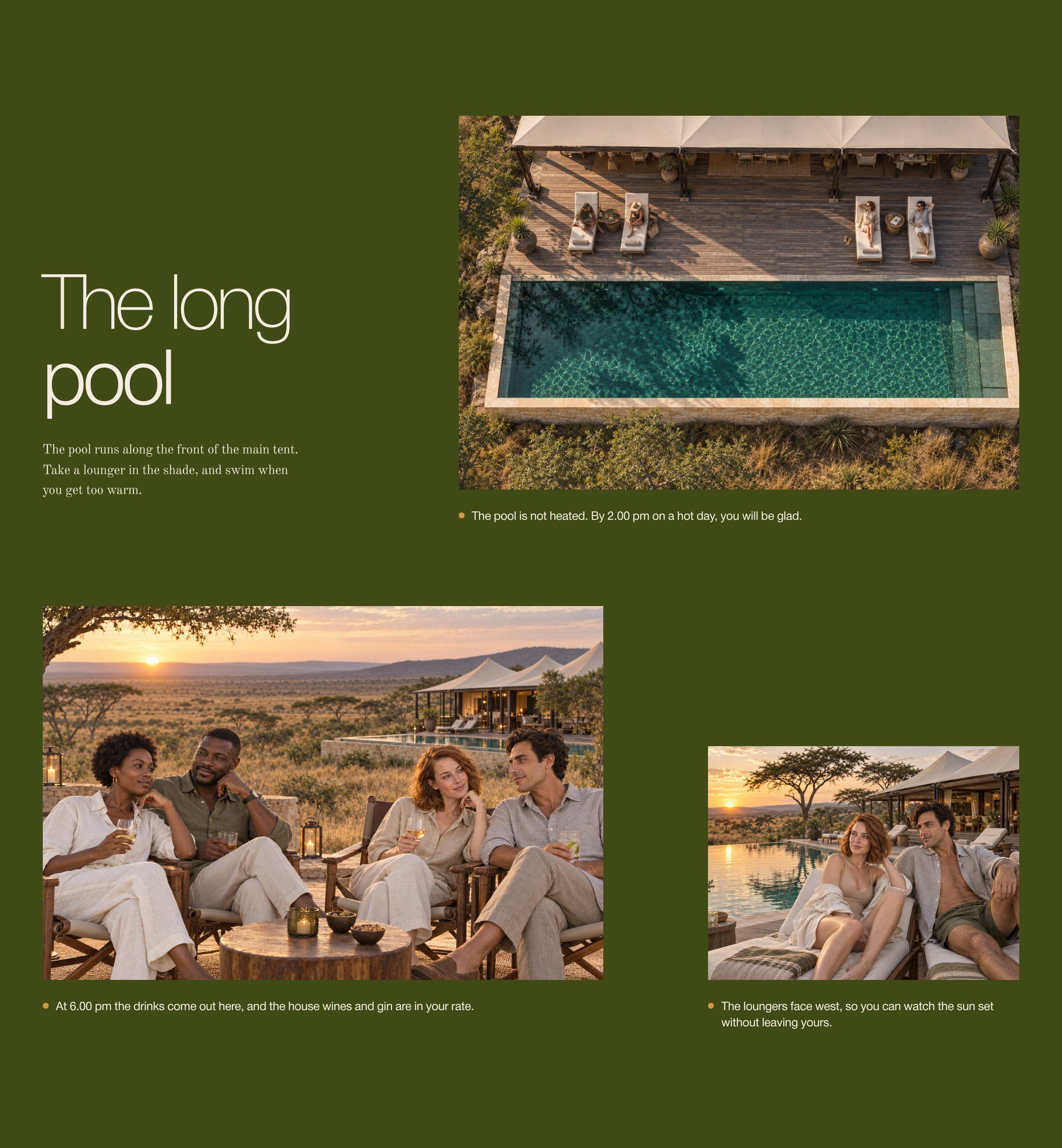
Then the captions add what the photo cannot show. Under an aerial photo of the pool, the caption on Mara Velour says “The pool is not heated. By 2.00 pm on a hot day, you will be glad.” A caption like that gives the guest a fact they will remember.
Large photos also have to stay sharp on a 27-inch screen and still load fast on a phone. I cover speed further down.
Each room type has its own facts
A guest choosing between three lodges wants to compare the rooms without writing to you. Give each room type the same short set of facts: how many guests, the bed, the bathroom, the view and who it suits.
andBeyond does this well. The accommodation page for Kichwa Tembo Tented Camp gives each tent type its own “Ideal for” line, with the room size and how many tents of that type there are. On the Tengile River Lodge page, the suite features sit in a plain list, from the private deck and pool to “Wheelchair accessible with assistance”.
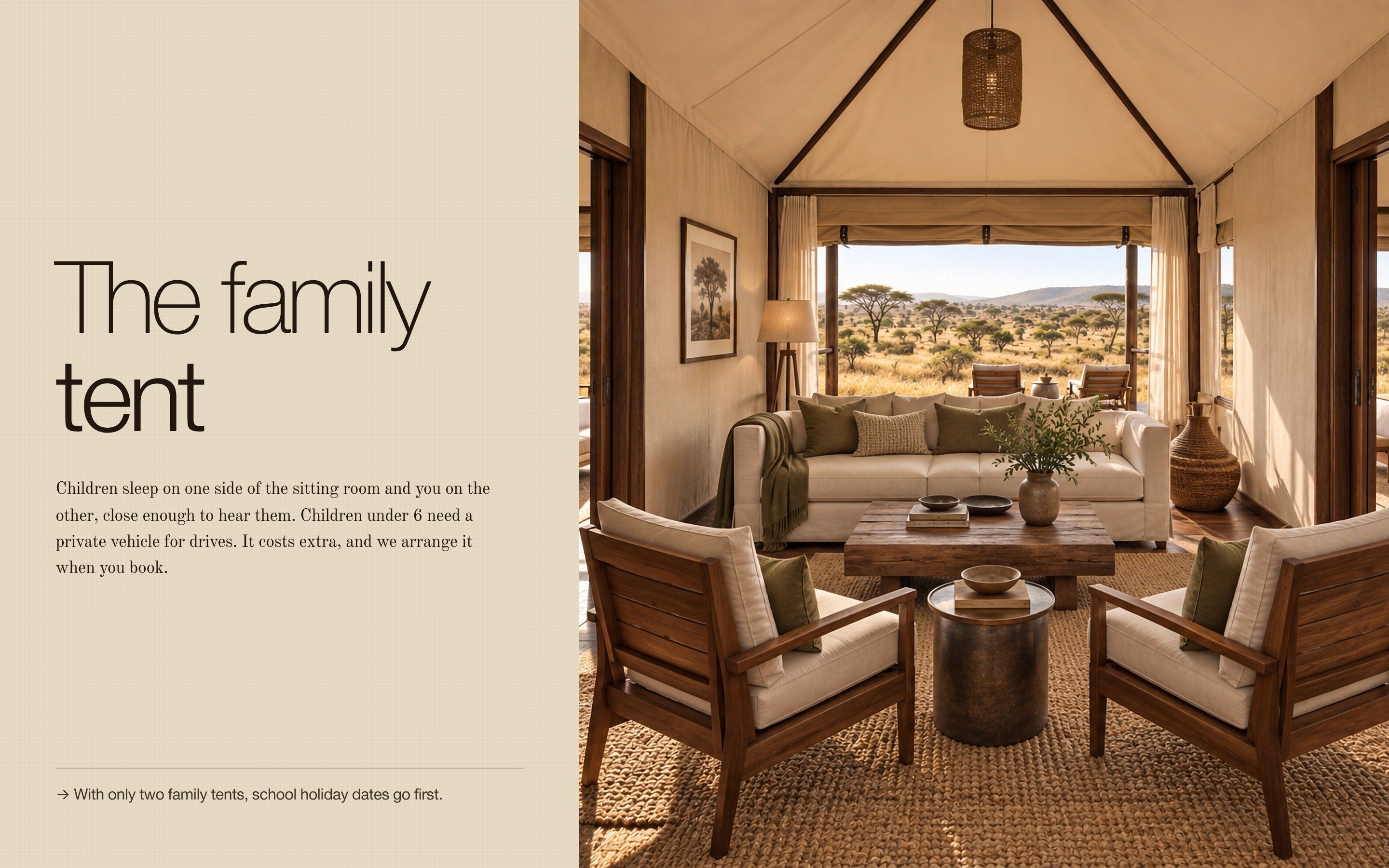
On Mara Velour there are six classic tents, four twin tents and two family tents. All three kinds get the same facts, on the bed, the deck, the bathroom and what is inside, plus one line on who should book it. The family tent has a note for parents: there are only two, so school holiday dates go first. That one line answers a question and gives a reason to send dates early.
Show your team by first name
Guests at this level pay for people as well as rooms. A lodge website that shows its guides and managers by name tells a guest who will look after them.
Nomad Tanzania’s home page has a section for its people that says “Nomad is our people. Many of us have been together from the beginning.” andBeyond’s Kichwa Tembo page describes its service as “the guide who remembers your favourite sundowner”.
On Mara Velour, “Who looks after you” shows four people. Each has a portrait, a first name, a job and one fact. Lemayian, the head guide, grew up 20 minutes from camp. Achieng, who manages the camp, writes back to your first email. Their names appear again where the guest will meet them. The arrival section opens with Lemayian shaking your hand at the airstrip.

When to come, and what it costs
Answer the two things guests want to know early, which month to come and roughly what it costs.
For seasons, give the months, the weather and what changes. The Tengile River Lodge page sets out summer from October to April and winter from May to September, then explains how to get there by air and by road. Asilia’s Naboisho Camp page gives each season with temperatures and rainfall.
For price, a “from” figure per person per night, with the months it covers, saves your guests and their agents an email. Bushtops shows its rates per person per night, sharing, in US dollars. The Tengile page publishes its 2026 and 2027 rack rates in rand, with the dates of each season. Angama Mara shows no figures. Its page says the rates are all-inclusive and points guests to its travel planners. For a newer lodge, I recommend a clear starting price.

Mara Velour gives two seasons by month, then a “from” price for each. November to June starts at USD 1,450 per person per night, sharing a tent. July to October starts at USD 1,950. Under the prices, the page lists what the rate includes and what costs extra, so the balloon flight is never a surprise on the bill. I wrote more on this in prices on your website.

An enquiry for guests and agents
Several of the best-known safari camps take dates through an enquiry and reply with a plan. Angama’s Mara page says its travel planners will be in touch, and Kichwa Tembo asks guests to enquire with a travel specialist. Your enquiry should tell them who will reply, how soon and what happens next.
On Mara Velour, the enquiry section gives the steps in order. The guest sends dates. The camp manager replies within 24 hours with the tents that are open and a first plan. A deposit holds the tents only if the guest likes that plan. A line under the form says that sending dates books nothing, and dates already picked in the booking bar on the first screen fill in the form.

If you sell through travel agents, they need facts they can paste into a proposal, and they need them fast. The big groups give agents their own door. andBeyond’s home page links to a Travel Trade Portal and an image library. Singita’s menu has “Trade Login & Rates Request“. Asilia has Agent Partnerships, and the Tengile MalaMala Collection has a Partner Hub. A smaller lodge can do the same with one page: room types, child policy, rates, what is included and a folder of photos to download. Mara Velour keeps it simpler: a line by the form invites agents to send dates for their clients there.
A phone number, and a fast page
Some guests want to talk before they pay a deposit. Put your reservations number and email where they can find them on every page. Sopa Lodges lists its Kenya and Tanzania reservation numbers at the foot of its home page, and Scarabeo Camp in Morocco gives its office number with the hours someone answers. If your team answers on WhatsApp, say so plainly.
A slow page loses guests before they see your first photo. Google’s guide to Largest Contentful Paint says “A good LCP value is 2.5 seconds or less”, which is roughly the time it takes for the biggest picture or block of text on the first screen to appear. A lodge site is full of large photographs, so I plan for this from the start. Each photo is prepared at full quality in several sizes, and the browser picks the one that fits the screen. A phone gets a phone-sized photo, and a 27-inch screen gets the large one, sharp. Motion follows the scroll, and if a guest’s device is set to reduce motion, everything shows at once.
Your luxury lodge website, point by point
Open your website on your phone and check these points one by one:
- The first screen names the place and what makes a stay different, with a way to check dates.
- The photos keep to good light, show whole faces and mix views, animals, people, details and food.
- Each caption adds a time, a name or a fact the photo cannot show.
- Each room type has the same short fact list and a line on who it suits.
- Each guide and manager appears with a first name, a job and a photo.
- Each season has its months, its weather and a “from” price.
- The page says what the rate includes and what costs extra.
- The enquiry says who replies, how soon and what happens next.
- Travel agents can find rates, facts and photos without emailing you.
- Your phone number, email and WhatsApp are on every page.
- The first screen loads in about 2.5 seconds on a phone.
To see the standard in full, look at the Mara Velour case study, read safari camp website design, or read about intimate luxury and the best safari lodge websites.
Short answers for lodge owners
What makes a luxury hotel or lodge website different from a normal hotel website?
The guest pays more, so they check more before they write. A luxury site shows each room with its own facts, the team by name, the months to come and a starting price, and it says who answers the enquiry. The photographs follow clear rules for light and framing, and the captions add facts the photo cannot show.
Should a luxury lodge show its prices online?
A “from” price per person per night, with the months it covers, helps guests and agents decide faster. Bushtops and Tengile River Lodge publish their rates. Angama Mara gives no figures on its page and says its rates are all-inclusive. For a newer lodge, I recommend showing where prices start.
Do I need a booking engine on my lodge website?
Not always. Several well-known safari camps, such as Angama Mara and andBeyond’s Kichwa Tembo, take dates through an enquiry and reply with a plan, because each stay includes flights and activities. If you use a form, say who replies and how soon. If most of your rooms sell night by night, a booking engine can sit beside the form.
How fast should a lodge website load?
Google’s web.dev guide calls a Largest Contentful Paint of 2.5 seconds or less good. Prepare each photo in several sizes so a phone downloads a phone-sized photo, while large screens still get a sharp one.
What do travel agents need from a lodge website?
Room types, child policy, what the rate includes, rates or a rates request, and photos they can use in a proposal. The large groups give agents a trade portal. A smaller lodge can put the same facts on one page with a folder of photos to download.

