
If you run a small lodge or a boutique safari camp, intimate luxury is what your guests pay for. Your size is the reason they choose you: a handful of tents and a team that learns their names. A website can hide that. Show the same pool, bed and sunset as a 60-room lodge, and the feeling of being one of very few guests is gone.
Intimate luxury is a feeling, and a guest decides whether you offer it long before they land. This article explains what the phrase means to the people who pay for it, and how a website lets them feel it from the first page. I show where the best small camps in the world get it right, and how I set it up on Mara Velour, a 12-tent safari camp brand and website I created.
What intimate luxury means to a guest
Intimate luxury is easiest to describe through moments. The guide who remembers what they came to see. A deck no one else can see into. A lion with one vehicle beside it. Lunch for two, away from the group.
When I plan a website for a small camp, I break intimate luxury into five parts:
- Few rooms, so there are few other guests.
- Privacy, in the tent and at the sightings.
- Being known by name, by people who stay with you all week.
- No crowds, backed by a rule, a place or a number.
- Time that belongs to you, with nothing on the plan you did not choose.
Singita puts this in one line on its home page: “With limited guest numbers, complete privacy and intuitive hospitality at every turn”. Each of the five parts can be shown on a website. Below is how.
Say how small you are, in numbers
“Intimate” is a word many lodges use. A number proves it. The best small camps put the count where a guest sees it.
Wilderness says on its Mombo page that the camp in Botswana’s Okavango Delta “has nine tents and accommodates up to 18 guests”, and that Little Mombo next door “accommodates just six guests”. Singita’s Mara River Tented Camp in northern Tanzania has six suites. Tengile River Lodge in South Africa’s Sabi Sand has nine. In India, Aman calls Aman-i-Khás an “intimate tented camp” and gives its fourteen tents on the same page.
A number works best with its reason in the same sentence. On Mara Velour, the number 12 sits large on the home page, with this line under it: “The whole camp, so the team knows your name by your first lunch.” On the Food & Drink page, the kitchen team “cook for 28 guests at most, so they soon learn what each of you likes.” The guest reads a count, then what the count means for them.
Show the space between the tents
Privacy is hard to photograph. A tent shot from the front looks the same whether the next tent is five metres away or sixty. So the website has to say it, and show it from a distance.
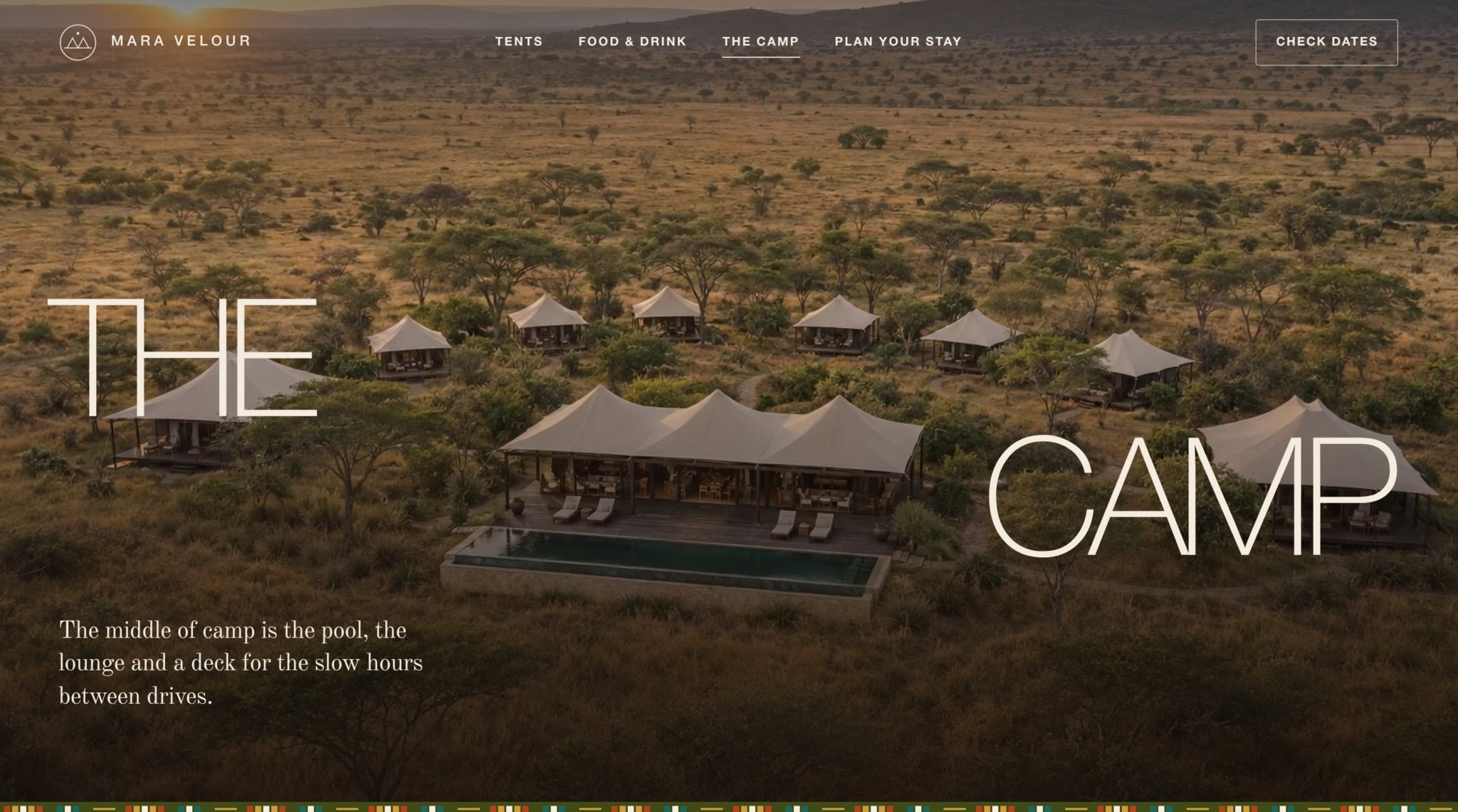
On Mara Velour, the tents page opens with “Twelve tents spread out on the grass, so your mornings on the deck are your own.” Next to the stone bath, a caption gives the distance: “The nearest tent is about 60 metres away, so nobody can see in.” The Camp page opens on an aerial photo of the tents spread out in the grass, so the guest can see the gaps for themselves.

Tengile River Lodge does the same in words. Its suite description talks about “a sense of seclusion” once you are inside, and lists a private deck and pool for each suite.
Write as if you know the guest
Being known by name is the hardest part of intimate luxury to show on a website, because the website cannot know the guest yet. It can show the people who will, and talk to the guest the way those people will.
andBeyond describes service at Kichwa Tembo as “the guide who remembers your favourite sundowner, the chef who adapts the menu to your tastes, and the smile that greets you by name.” Nomad Tanzania’s home page shows a guest review that thanks a member of staff by her first name.
On Mara Velour, every page is written to one guest, in the second person, with the team named. A few lines from the site:
- “Your group has the same guide every day, so by day two your guide knows what you came for.”
- “Wanjiru, our head chef, writes the menu around you. By day two, nobody asks how you like your eggs.”
- “Tell the team at breakfast, and they set your table away from the group.”
- “After dark, Parsimei, our night guard, walks you to your tent.”
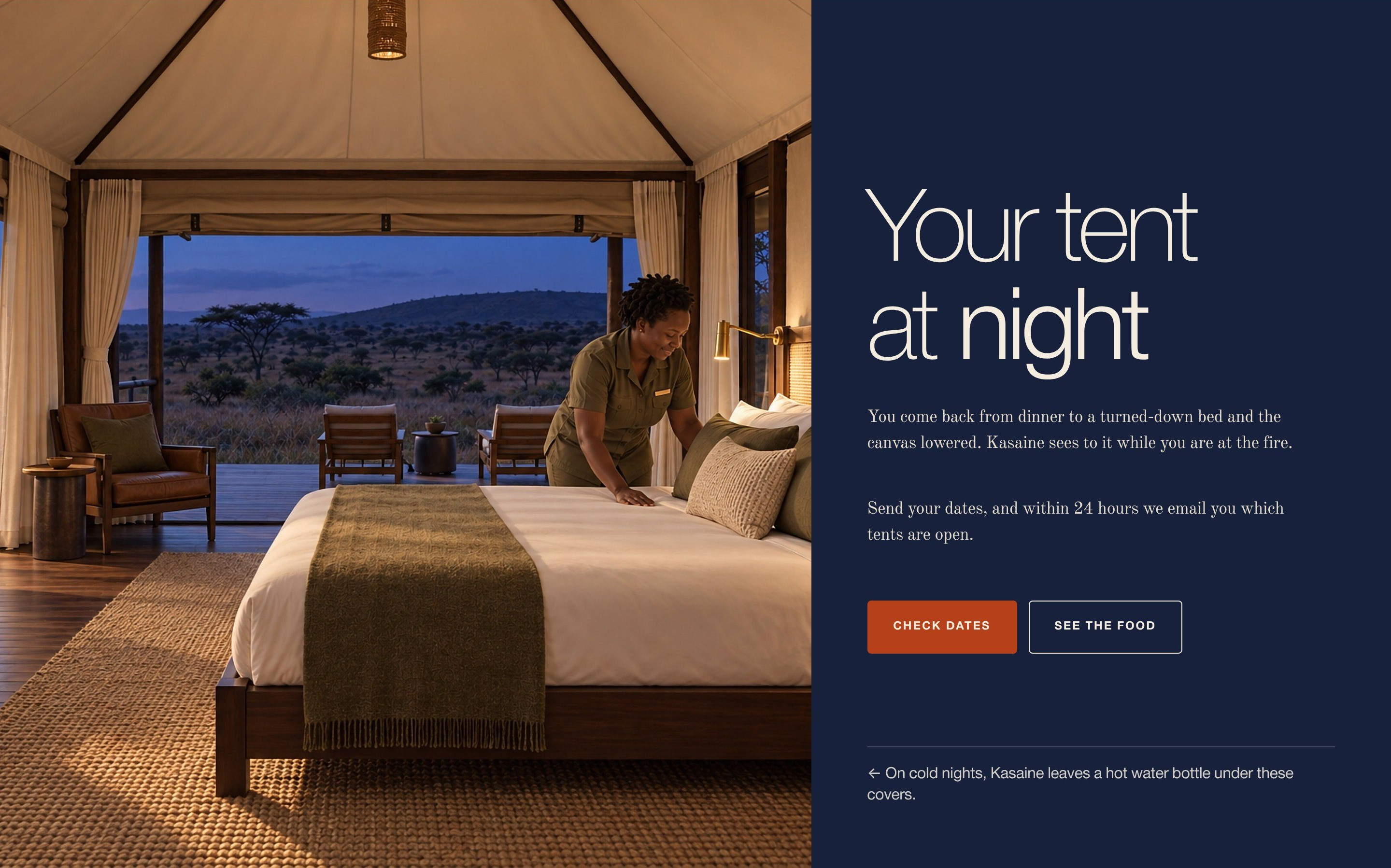
Each line names a person or a time. Together they tell the guest that someone will pay attention to them, without a single “personalised service” claim.
Prove the quiet with a rule
The fear behind intimate luxury is the crowd. A couple pays for a quiet safari and finds 20 vehicles round one lion. To calm that fear, give the guest a rule they can read.
Asilia’s Naboisho Camp page explains that from June to September the national reserve is busy with the migration and the visitors it brings, while the conservancy next door still offers game viewing “without the crowds”. andBeyond’s Tengile River Lodge page mentions “Strict vehicle limits at sightings”.
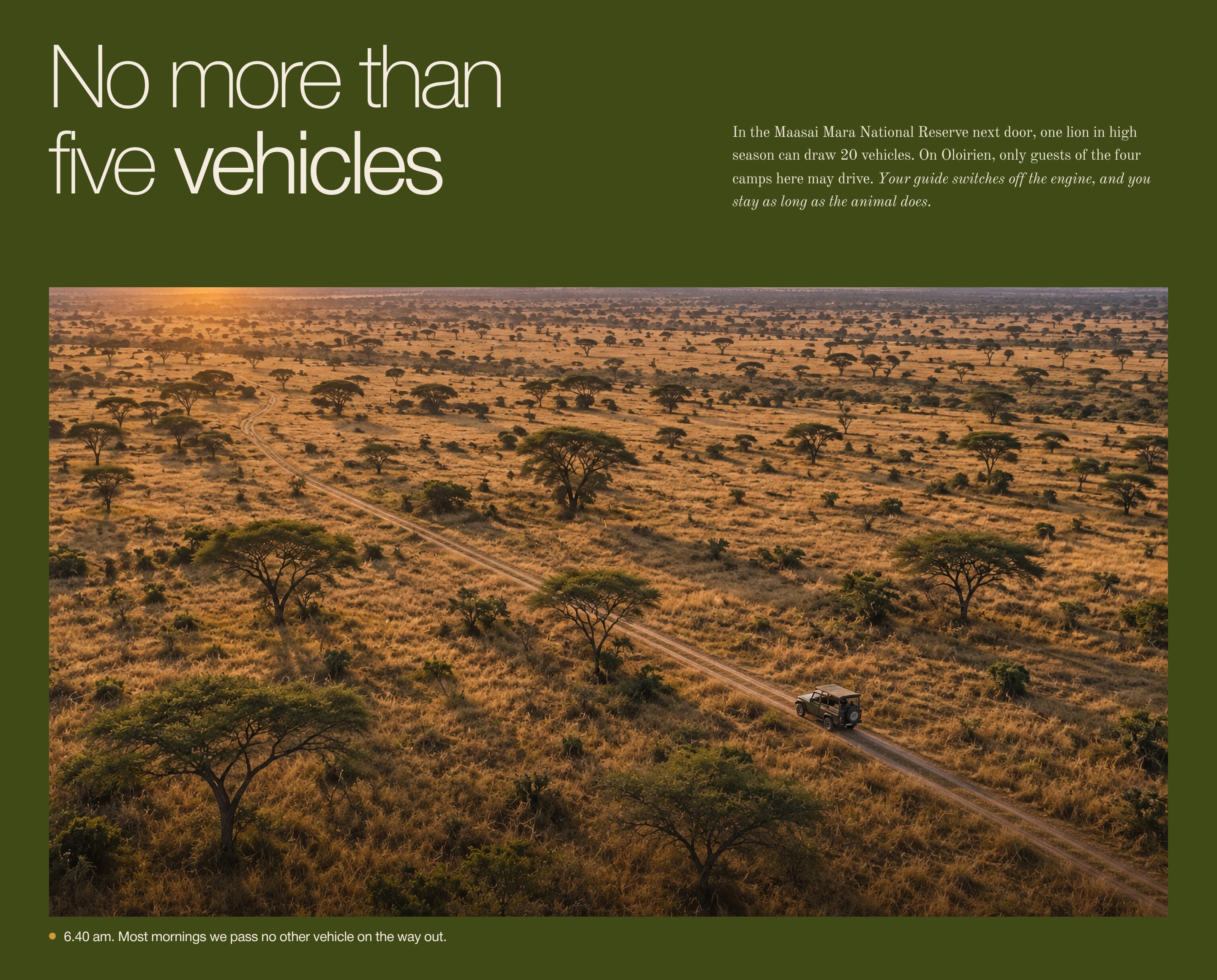
Mara Velour puts the rule in the heading itself, “No more than five vehicles”. Under it, an aerial photo shows one vehicle on an empty track at sunrise, with the caption “6.40 am. Most mornings we pass no other vehicle on the way out.” Four numbers follow: 12 tents, 5 vehicles at a sighting, 350 acres for each guest bed and a 45-minute flight from Nairobi.
Let the page slow down
A small camp sells unhurried days, so its website should not hurry the guest. Pop-ups and a row of buttons on every block work against the calm you are selling.
On Mara Velour, I gave each section plenty of space. Headings are set in a thin weight with one phrase heavier. The body text is set in Old Standard TT, which reads like a printed travel journal. There is one button label across the site, “Check dates”, in one colour. When the guest reaches “Evenings by the fire”, the page turns slowly from Linen to Dusk blue, as the sky does at camp.
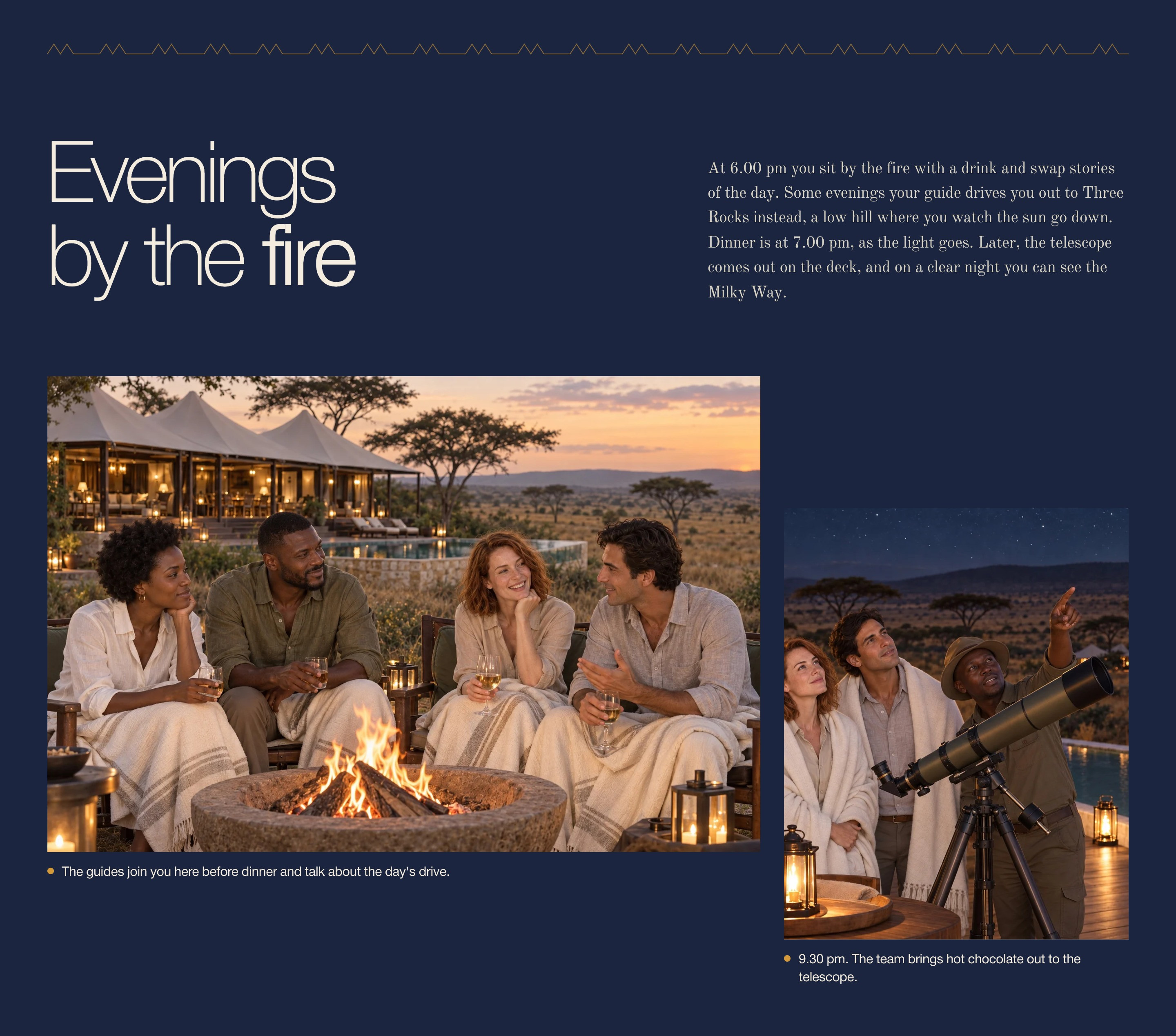
The words slow down too. “Nobody expects you anywhere until the 4.00 pm drive.” The home page shows a five-night stay one day at a time, and opens with this line: “Each evening, you and your guide plan the next day around what you most want to see.”

Legendary Expeditions uses this idea as a name. On its home page, Chem Chem Lodge in Tanzania is “The home of the Slow Safari”, and Forest Chem Chem is “Reserved exclusively for sole use”.
Private moments, each with a time
Privacy is easier to believe when it has a time and a place. So on Mara Velour, I named each private moment and gave it a time or a person.
Kipeen, a Maasai ranger born on the conservancy, walks you out to read the night’s tracks. On another morning, breakfast is laid out on the front of the vehicle, with coffee in a flask. On warm nights, dinner is served by the pool, one course at a time by lantern light. And at 2.30 pm, Wanjiru teaches the cooking class, and you eat what you made at dinner.
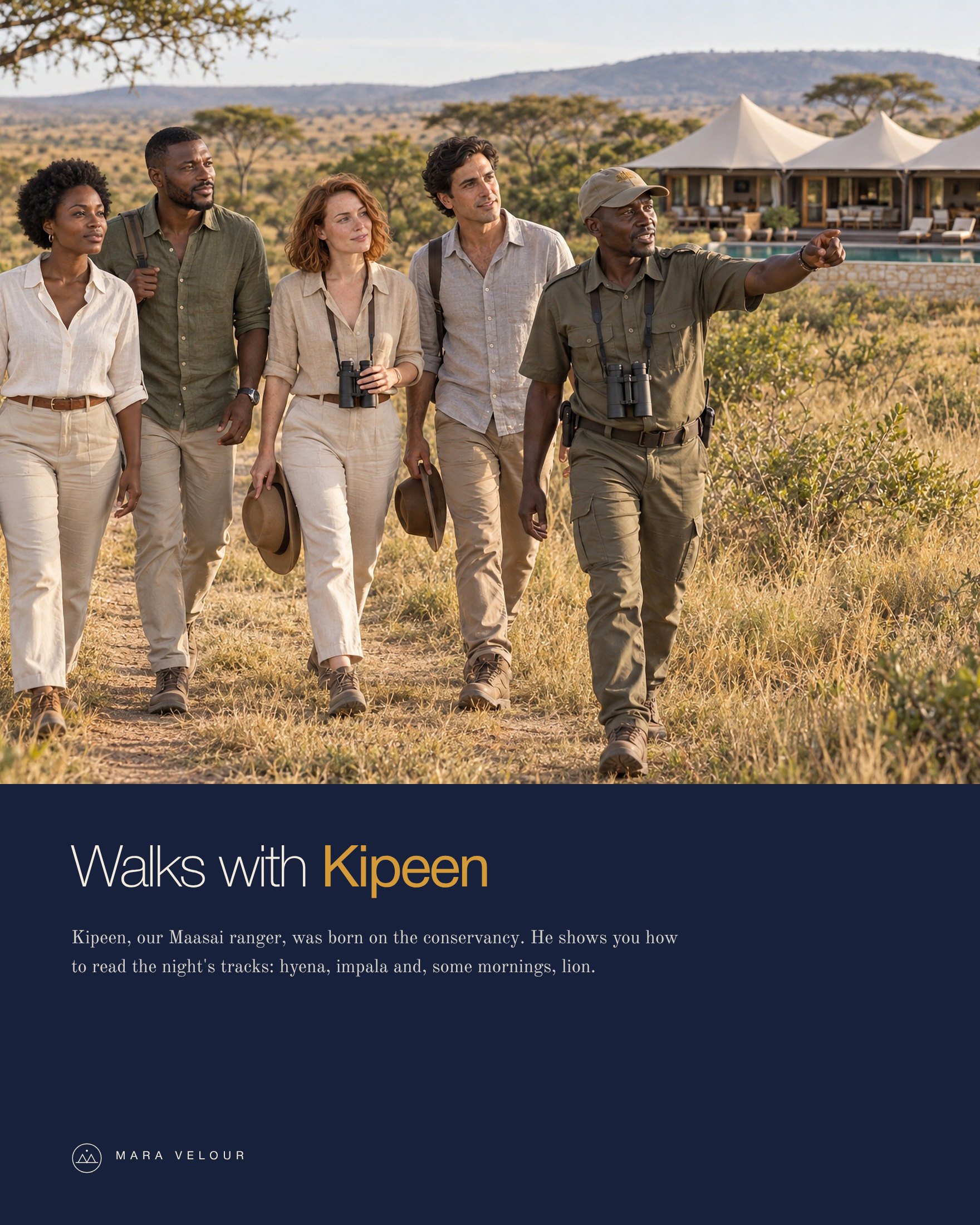
A guest reading this can see their own week. That is what makes a small camp feel personal before arrival.
Words that undo the feeling
Some words make a small camp sound like a big hotel. I left these out of the Mara Velour brand voice from the first day: “unforgettable”, “breathtaking”, “once in a lifetime”, “luxury redefined” and lines built as “where X meets Y”. Reviews and awards the camp does not have stayed out as well.
In my brand notes, the camp’s voice is “Quiet, warm and exact, like a good host walking you to your tent.” Plain words about what the guest will see, hear and do. The photos carry the beauty, and the copy carries the facts.
A checklist for a small lodge
Use this to test how well your website shows intimate luxury:
- Your room count is on the home page, with what it means for the guest.
- A photo or caption shows the distance between rooms or tents.
- Your guides, chef and manager appear by first name, with one fact each.
- The copy speaks to one guest and names times, places and people.
- A rule, a place or a number backs up your claim of no crowds.
- Private moments are named with a time, and the price is clear if they cost extra.
- The page has one main button and no pop-ups that interrupt reading.
- Words such as “unforgettable” and “breathtaking” are gone.
For the whole camp website, see the Mara Velour case study and how I directed it, or read what a luxury lodge website needs and what the best safari lodge websites get right.
Short answers on intimate luxury
What does intimate luxury mean?
It means a small number of rooms or tents, privacy, a team that knows each guest by name and no crowds. Guests pay for the feeling that the place and the people are there for them. In a safari camp, it often also means a limit on vehicles at a sighting.
How many rooms does a boutique safari camp have?
There is no fixed number. Some of the best-known camps in Africa are very small. Wilderness Mombo in Botswana has nine tents for up to 18 guests, according to its camp page, and Singita’s Mara River Tented Camp has six suites.
How can a small luxury lodge look different from a big hotel online?
Show your room count with what it means for the guest, name your team, give distances and times in your captions and back up “no crowds” with a rule or a number. Keep the page calm, with one main button and plain words.
Should a small lodge show its guides and staff on its website?
Yes. Guests at a small lodge are buying the people as much as the rooms. A portrait, a first name, a job and one fact for each person lets a guest know someone before they arrive.
Which words should a luxury lodge avoid on its website?
Words many lodges use, such as “unforgettable”, “breathtaking” and “once in a lifetime”, and claims such as “luxury redefined”. Replace them with facts the guest can check: a time, a distance, a name or a rule.

