
If you own a safari lodge or camp, your website sits next to the best safari lodge websites in the world. A guest planning a big trip may open yours, then Singita’s, then Angama’s, on the same evening. They compare more than the photos. They compare how fast they can answer their own questions.
Any lodge website I plan has to hold up next to these sites, so I know them well. Each one below does at least one thing better than most, and I link to it so you can open it and compare. At the end, I show where Mara Velour, a 12-tent camp brand and website I created, meets the same standard and where it goes further, with a checklist for your own site.
These are the six things I look for on every lodge website:
- A first screen that says where you are and lets a guest check dates.
- Rooms or tents with their own facts.
- The team, shown by name.
- Seasons, getting there and a price, or a clear way to ask for one.
- An enquiry that says what happens next.
- A clear door for travel agents.
Singita, for planning a trip
Singita runs 10 lodges and 9 villas in five countries, and its home page is built for a guest who already wants to go. A bar on the page lets you pick a region, a lodge, dates and the number of guests, then “Check availability”. The menu holds a rates page where every lodge has its own “View rates” link, and a separate “Trade Login & Rates Request” for agents.
Each camp page has room for detail. The page for Mara River Tented Camp, in the Lamai Triangle of northern Tanzania, gives the number of suites, six, and explains the food, the wellness and how the camp runs on solar power. The writing is careful and the photographs are large.
This is the clearest example I know of the first point on my list. A guest can go from “where is it?” to “can we come on our dates?” without leaving the first page.
Angama, for the story
Angama Mara sits on the edge of the Great Rift Valley above Kenya’s Maasai Mara, and its page gives the numbers inside plain sentences. Two separate camps, each with 15 tented suites. About 1,000 feet above the plains. A short 45-minute flight from Nairobi.
The page answers guests in the order they ask. “The Perfect Stay” starts from the question of how many days to stay. “How to Get Here” follows. Then a section of details covers the number of tents, children and families, malaria, seasons and temperatures, and check-in times. Angama gives no rate figures on the page. It says its rates are all-inclusive and asks guests to contact its travel planners.
Angama’s journal is called “Leaving Out The Dull Parts“, with posts by members of the team, such as Japheth Supeyo, a photographer who worked in Angama’s photographic studio. A post called “A Beading Safari” names the women in its captions, such as Mamma Elizabeth. A guest who reads it meets people before they arrive.
Tengile River Lodge, for calm detail
Tengile River Lodge sits on a bend of the Sand River in South Africa’s Sabi Sand. andBeyond’s page for it mentions “Strict vehicle limits at sightings” and game drives across 10,500 hectares. The lodge also has its own page on the Tengile MalaMala Collection website, which lists it with nine suites.
That second page is one of the most complete lodge pages I know. It lists the suite features one per line. It publishes rack rates for 2026 and 2027, per person sharing per night, with the dates of each season. It gives the child policy in full, health advice, the weather by season and how to get there by air and by road. The menu has a Partner Hub for agents. All of it sits in a quiet palette of olive green and soft parchment shades, with a lot of space around the text.
This is the standard I set for a Plan Your Stay page. Every answer a guest or an agent needs sits on one page, in a calm layout, and nobody has to write an email to find the child policy.

Nomad Tanzania and Asilia, for people
Nomad Tanzania’s home page carries a dated migration update, which tells a guest the site is kept current. A section on its people says “Nomad is our people. Many of us have been together from the beginning.” Guest reviews on the same page name staff, such as one that thanks the team at Entamanu “and especially Sarah”. The gallery captions name the camp in each photo, such as “Breakfast with endless Serengeti views from Lamai Serengeti.”
Asilia’s home page has a section called “Our People”, and its guest reviews carry the reviewer’s first name. The menu has a link for Agent Partnerships. On the page for Naboisho Camp in Kenya, three practical facts sit in capitals near the top: the nearest airstrip is a 45-minute drive, children aged 5 and older are welcome, and the camp is open all year. Further down, each season has its temperatures and rainfall, and the rates are shown per person per night in US dollars. The page also explains that tourism fees pay for running the conservancy and for lease payments to the Maasai landowners.

East Africa’s other big names
Legendary Expeditions says on its home page that it and Chem Chem Safari have joined the Auberge Collection, with nine properties in Tanzania now under one name, Auberge Safari. Its suggested trips are a good model for agents and guests alike. Each one gives the number of nights, a short paragraph and a “Download brochure” link.
Bushtops, with camps in the Maasai Mara and the Serengeti, gives occasions their own place in the menu. Under “Celebrate” sit family safaris, honeymoons, vow renewals, weddings and anniversaries. The home page links to a live stream from Mara Bushtops, and the rates page shows prices per person per night, sharing, in US dollars.
The Elewana Collection describes itself as 16 boutique lodges, camps and hotels in Kenya and Tanzania. Its menu is built for planners, with Online Availability, Fast Facts and Downloads, and the reservations phone number and email sit at the foot of the page. Elewana’s newer brand has its own site. According to DOTW News, Serengeti Explorer opened in 2025 as the first property of Explorer by Elewana. The Serengeti Explorer website carries the line “© Explorer By Elewana” and has pages for seasons and rates, and a live camera.
Sopa Lodges keeps its site simple and useful. The home page lists its six properties, five in Kenya and one in Tanzania, each with its park and a short description. The menu has Online Availability, Downloads and a page for meetings and conferences, and the reservation numbers for both countries sit at the foot of the home page.
Five camps beyond East Africa
A guest from London or New York compares your site with lodges all over the world. These five are worth knowing, each for one thing it does very well.
Londolozi in South Africa marks 100 years of safari on its home page, from 1926 to 2026, and says that in 1993 it became the first game reserve in the world to receive Relais & Châteaux status. Its blog names the animals in its photos, such as the Nhlanguleni Female. In Botswana, the page for Wilderness Mombo says plainly that the camp has nine tents for up to 18 guests, and answers practical questions, such as malaria, in short written answers.
Scarabeo Camp is a desert camp in Morocco’s Agafay, below the Atlas mountains. Its menu comes in French and English, each of its two camps shows its GPS location, and the office number is given with the hours someone answers. Adrère Amellal, an eco-lodge in Egypt’s Siwa Oasis, has 40 hand-built rooms and no electricity, lit by beeswax candles, and the photos on its home page carry the photographer’s name. In India, Aman calls Aman-i-Khás “this intimate tented camp”, with fourteen tents on the edge of Ranthambore National Park, and the camp menu has its own pages for wildlife safaris and getting here.
Where Mara Velour goes further
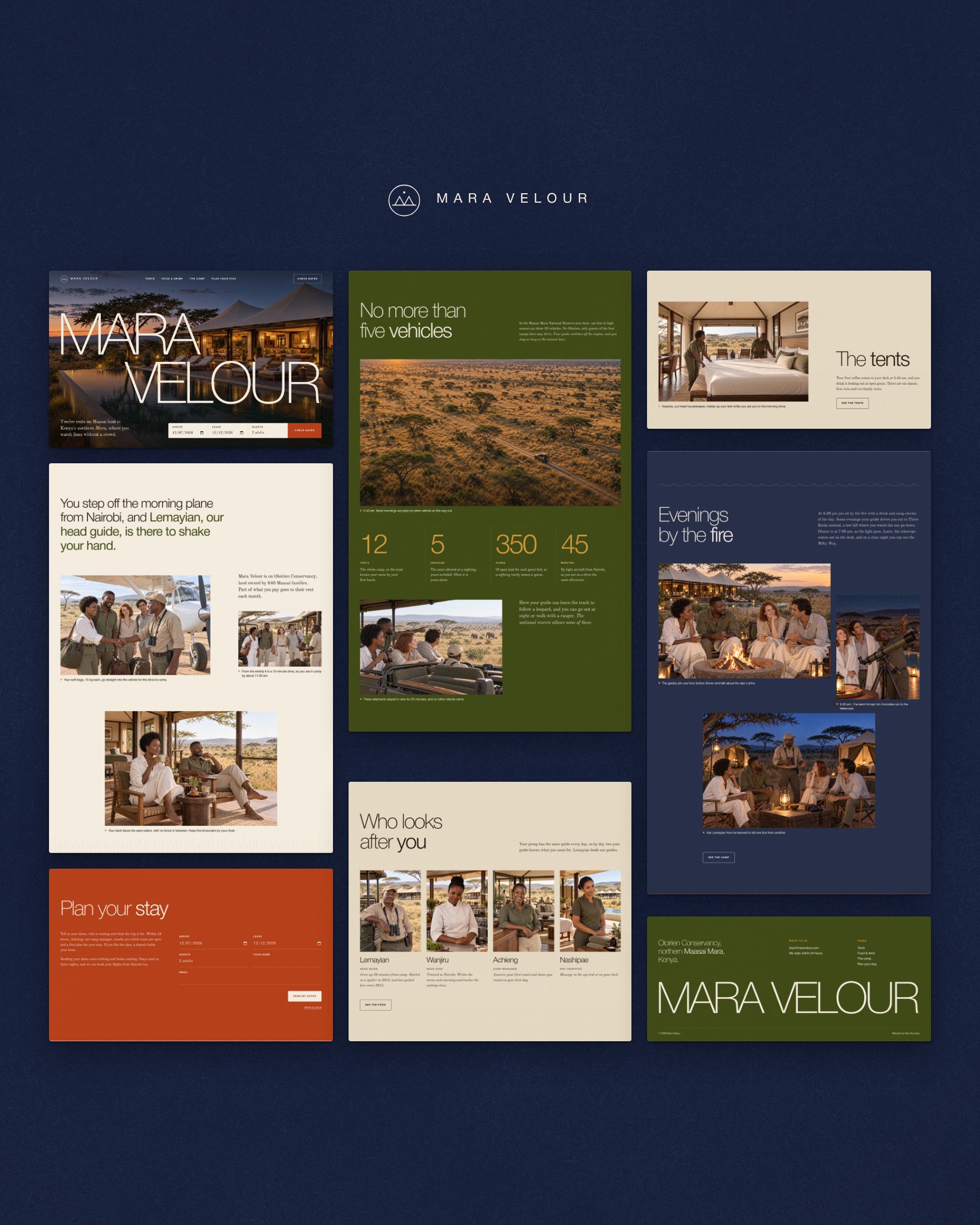
Mara Velour is a 12-tent camp brand on a Maasai-owned conservancy in Kenya’s northern Mara. I created the brand, wrote the copy, directed the imagery and built the five pages: Home, The Tents, Food & Drink, The Camp and Plan Your Stay. It meets all six points on my list, and adds four of its own.

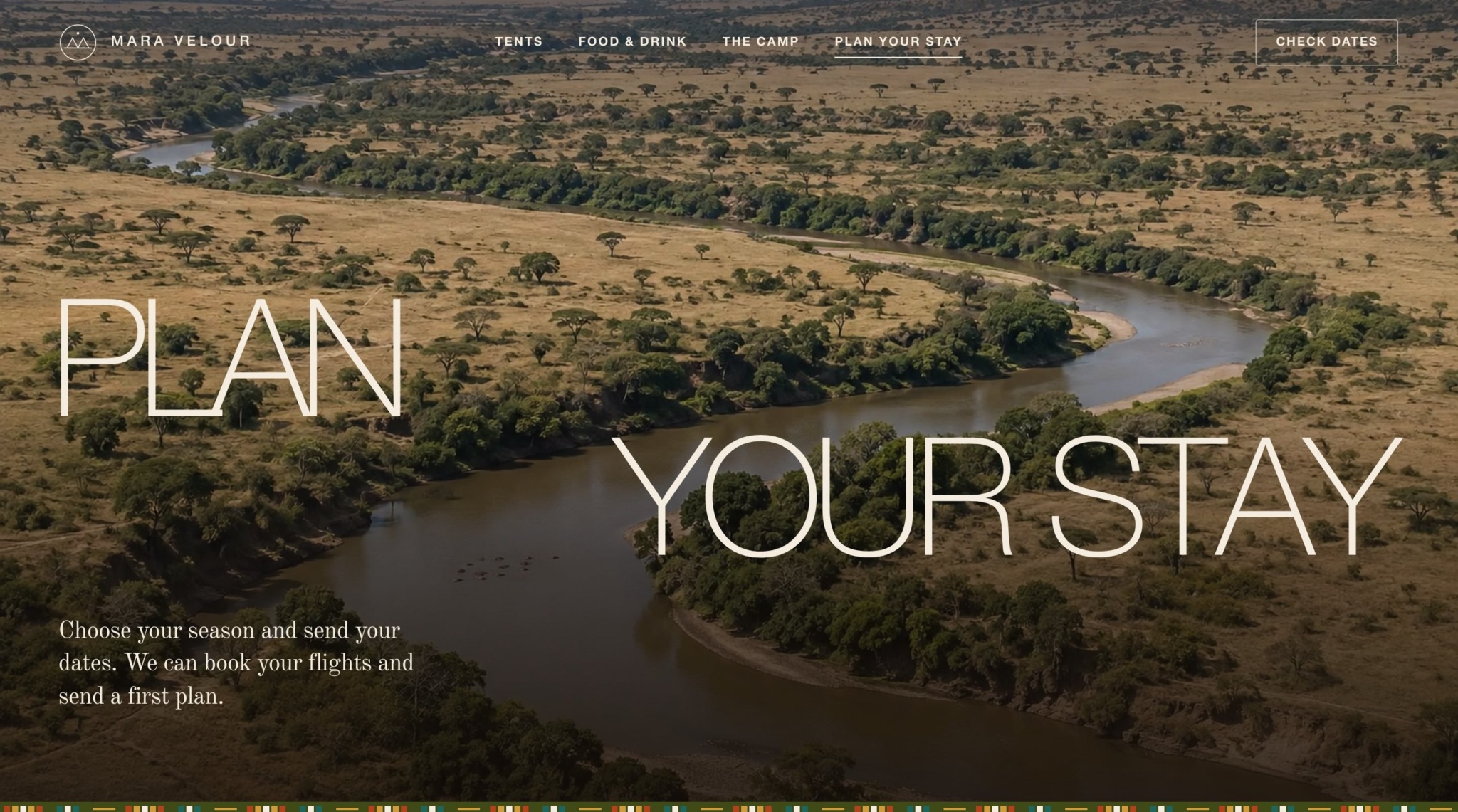
- The first screen. One line names the place and the difference, “Twelve tents on Maasai land in Kenya’s northern Mara, where you watch lions without a crowd”, with a booking bar for dates and guests under it.
- The tents. Three types, six classic, four twin and two family, each with a fact list and a line on who it suits.
- The team. Four people with portraits, first names, jobs and one fact each. Lemayian, the head guide, meets the plane. Achieng, the camp manager, answers the first email.
- Seasons and price. Two seasons by month, a “from” price for each, and a list of what the rate includes and what costs extra.
- Getting there. A drawn map of the 45-minute flight from Wilson Airport, with the time to be at the airport and the luggage limit for light aircraft.
- The enquiry. Send your dates, and within 24 hours the camp manager emails which tents are open and a first plan. Agents can send dates for their clients on the same form.

The four additions are where Mara Velour goes further than the sites above. First, every caption gives a time or a fact the photo cannot show, such as “9.30 pm. The team brings hot chocolate out to the telescope.” Second, the site has one button label, “Check dates”, always in the same burnt orange, a colour kept for booking. Third, the five-night stay is shown day by day, from the first drive at 4.00 pm to a night drive with a red spotlight. Fourth, the page follows the light of a day at camp, and turns from Linen to Dusk blue when the guest reaches “Evenings by the fire”.

You can see the whole site, page by page, in the Mara Velour case study, and read how I directed it from brand to five pages.
What the best safari lodge websites share
Here is what the best safari lodge websites have in common, as a list you can check your own site against. Next to each point is the lodge I would show you first.
- A booking bar or dates form on the first screen, as on Singita’s home page.
- Numbers inside sentences, with the reason beside each, as Angama does.
- Rates, child policy, health, weather and getting there on one page, as on Tengile’s.
- Your people by first name, as Nomad Tanzania and Asilia show them.
- Trips with the number of nights and a brochure to download, as Legendary offers.
- Occasions such as honeymoons and anniversaries with their own page, as Bushtops does.
- Online availability, fast facts and downloads in the menu, as Elewana and Sopa have.
- Captions that give a time, a place or a name.
For more on the details, read what a luxury lodge website needs, intimate luxury and safari camp website design.
Short answers on lodge websites
Which safari lodges have the best websites?
Singita, Angama and Tengile River Lodge set a high standard in Africa, and Nomad Tanzania and Asilia stand out for showing their people. Beyond East Africa, Londolozi in South Africa, Wilderness Mombo in Botswana and Aman-i-Khás in India are worth studying. Each does one or two things better than the rest.
What should a luxury safari camp website include?
A first screen that names the place and lets guests check dates, a fact list for each room or tent, the team by name, seasons by month, how to get there, a price or a clear way to ask for one, and an enquiry that says who replies and how soon. A page for travel agents helps too.
Do the best safari lodges publish their rates?
Some do and some do not. Tengile River Lodge, Bushtops and Asilia’s Naboisho Camp show rates on their pages. Angama gives no figures on its page, says its rates are all-inclusive and asks guests to contact its travel planners.
What are the most luxurious safari lodges in Africa?
There is no single list, and guests weigh different things. The lodges in this article are among the best known, from Singita and Angama Mara to Londolozi and Wilderness Mombo. Each has a website worth opening before you plan yours.
How can a small camp compete with Singita or Angama online?
By being as clear as they are, and more personal. Give your numbers with reasons, name your team, publish a “from” price and say who answers the enquiry. A small camp can also give every caption a time or a name, because the team knows the story behind each photo.

