
A brand manager has your name from a friend, or from a post someone sent her. She has a collection going on sale in March, a budget and three other studios to look at. Between two meetings, she opens your art director website on her laptop and gives it a few minutes.
In those minutes she wants to know five things. Is the work right for her label? Who directs the shoot? How long does it take? Who owns the pictures afterwards? How does she reach you? When your website answers all five, she sends a brief. When it answers two, she opens the next name on her list.
Below are the points brands and agencies check on an art director’s, photographer’s or creative studio’s website, and how the strongest studios in the world handle each one. For each point, I show what I chose for Luz Gémea, a campaign studio brand and website I created. Luz Gémea is an art director’s studio in Santos, Lisbon, for fashion and beauty brands. Its director runs the photographer and the film crew together on the same set. At the end there is a checklist you can use on your own website.
Open with the work, and name it
Her first question is whether your work is good enough for her label. She decides by looking at the pictures, before she reads a word. So the work comes first, and only your best work.
Photographers who sell to brands say the same thing. In Wonderful Machine’s guide to curating a photographer’s website, photographer Jonathan Meter says, “I judge the website by the worst picture, not the best picture.” The same guide tells photographers that each gallery “should start strong and confident with the images you are most proud of.”
The strongest agencies also name each job. On Art Partner’s home page, each campaign carries the artist, the brand and the season, such as Glen Luchford for Valentino, FW26. Spring Studios, a creative agency in Milan, London and New York, puts a short label on each project, such as Campaign or Creative Direction, with one line on what it was. A brand manager sees what was made, and for whom.
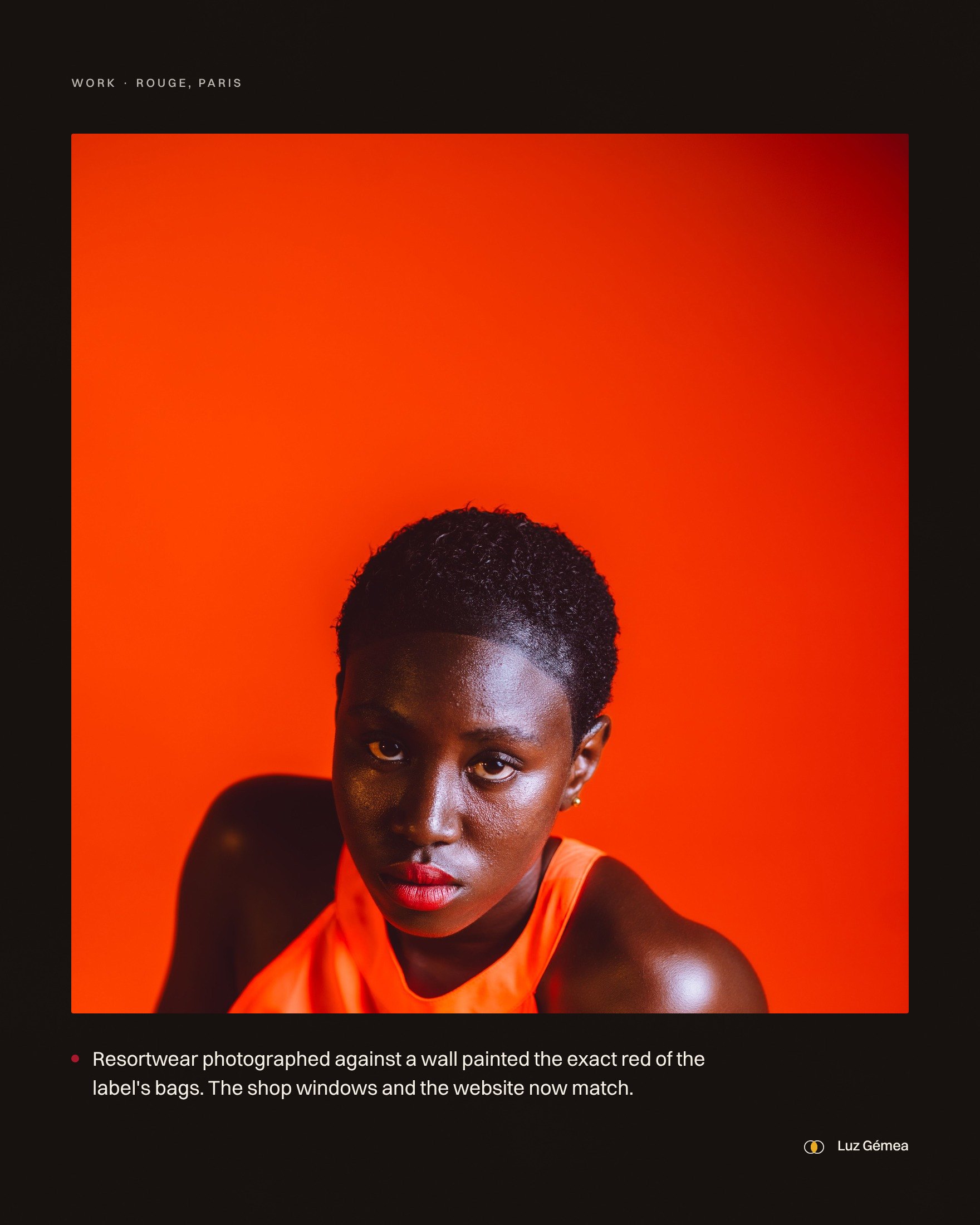
On Luz Gémea, the first screen puts three campaigns side by side, so a visitor sees the range of the studio before reading anything. Further down, a section called “Campaigns people stopped for” holds six campaigns from six cities. Each has a large photograph and two lines on what the brand wanted. Under Rouge, Paris, it reads: “Resortwear photographed against a wall painted the exact red of the label’s bags. The shop windows and the website now match.”
Pick fewer campaigns and say what each brand asked for. A brand manager can then picture her own brief in your work.
Put the films beside the stills
A campaign can run on a billboard, in a shop window and on a phone in the same week. If you shoot film as well as photographs, put it where a brand can find it in one click.
Strong photographers give film its own place in the main menu. Tim Walker’s website lists Moving Image in its main menu, with Selected Work, Portraiture and Stories. Tyler Mitchell’s lists films beside photography, and Campbell Addy’s has Films beside Selected Works.
On Luz Gémea, the films section is called “Your campaign, in motion”. It holds four short films, cut for the brand’s website, shop screens and each social format, and filmed on the same days as the photographs. On a phone, the four films sit in a row you swipe. Later on the page, the founder says why this is the studio’s whole idea:
When the film and the photographs look like two different shoots, the customer feels it before she can say why.

Say who directs the shoot
A brand is also choosing the person who will run its shoot. She wants to know who will be behind the camera on the day, and what that person has done before.
The production company Somesuch has a Directors page that lists every director by name. On its home page, each film is credited to its director, such as Kim Gehrig for Foot Locker. Tim Walker’s home page opens with his story. It names the magazines his pictures have appeared in, such as Vogue, Vanity Fair and i-D, and says he has published seven books.
On Luz Gémea, a violet section called “From feature films to fashion” tells the director’s story in two short paragraphs. The page says Duarte Valadas spent ten years behind the camera on Portuguese feature films, then opened the studio in 2014 in a former warehouse in Santos, Lisbon, to light fashion the way he had lit films.
One number on the page answers a question a brand may not ask out loud, which is whether the person whose work she liked will be on set. It reads: “12 campaigns a year, so Duarte can direct every one himself.”

Show how a shoot runs, with timings
A brand manager works back from her launch date. She needs to know when she gets the plan, when she sees the first pictures and when the final files arrive. If your website gives her those dates, she can take your name to her boss.
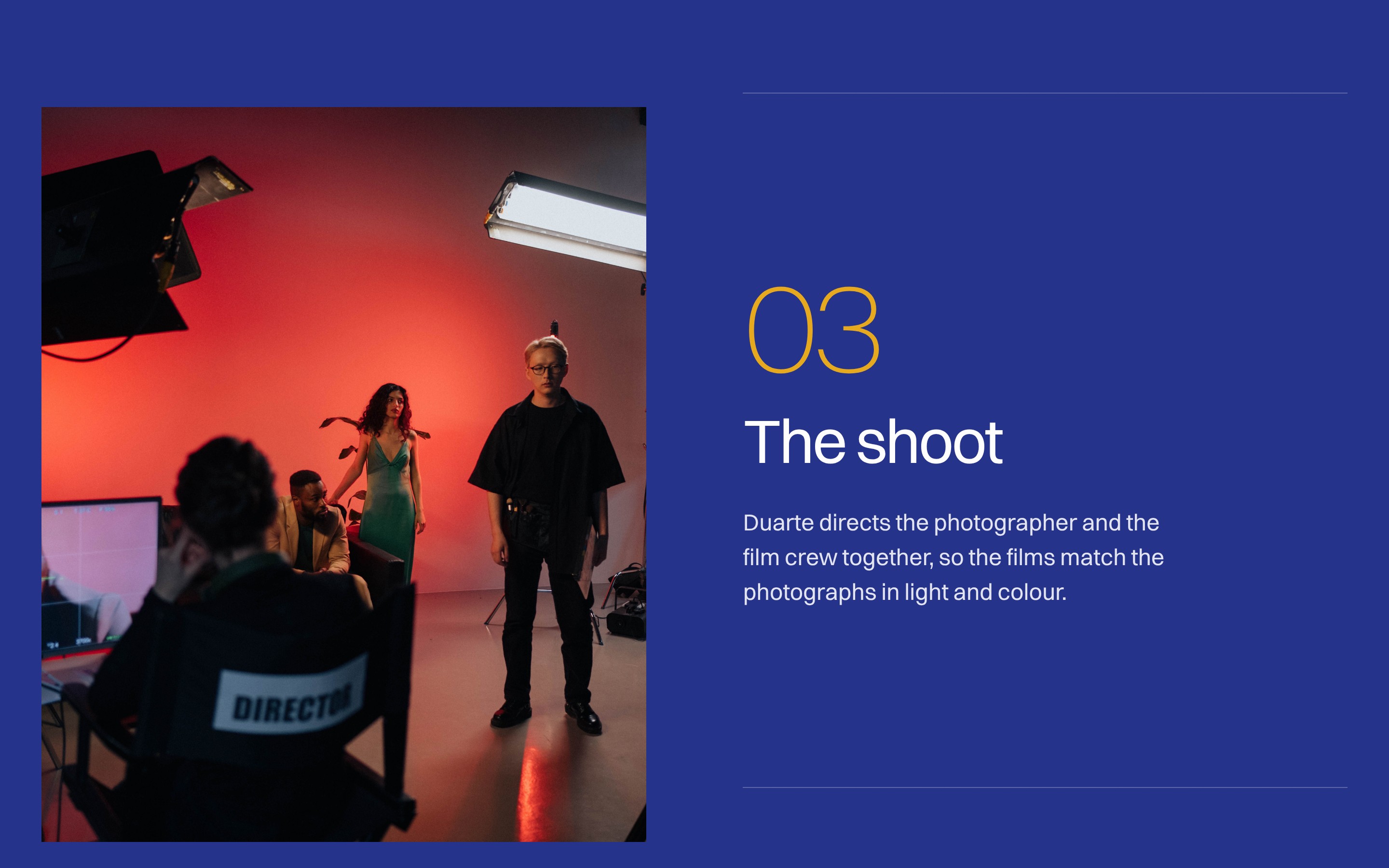
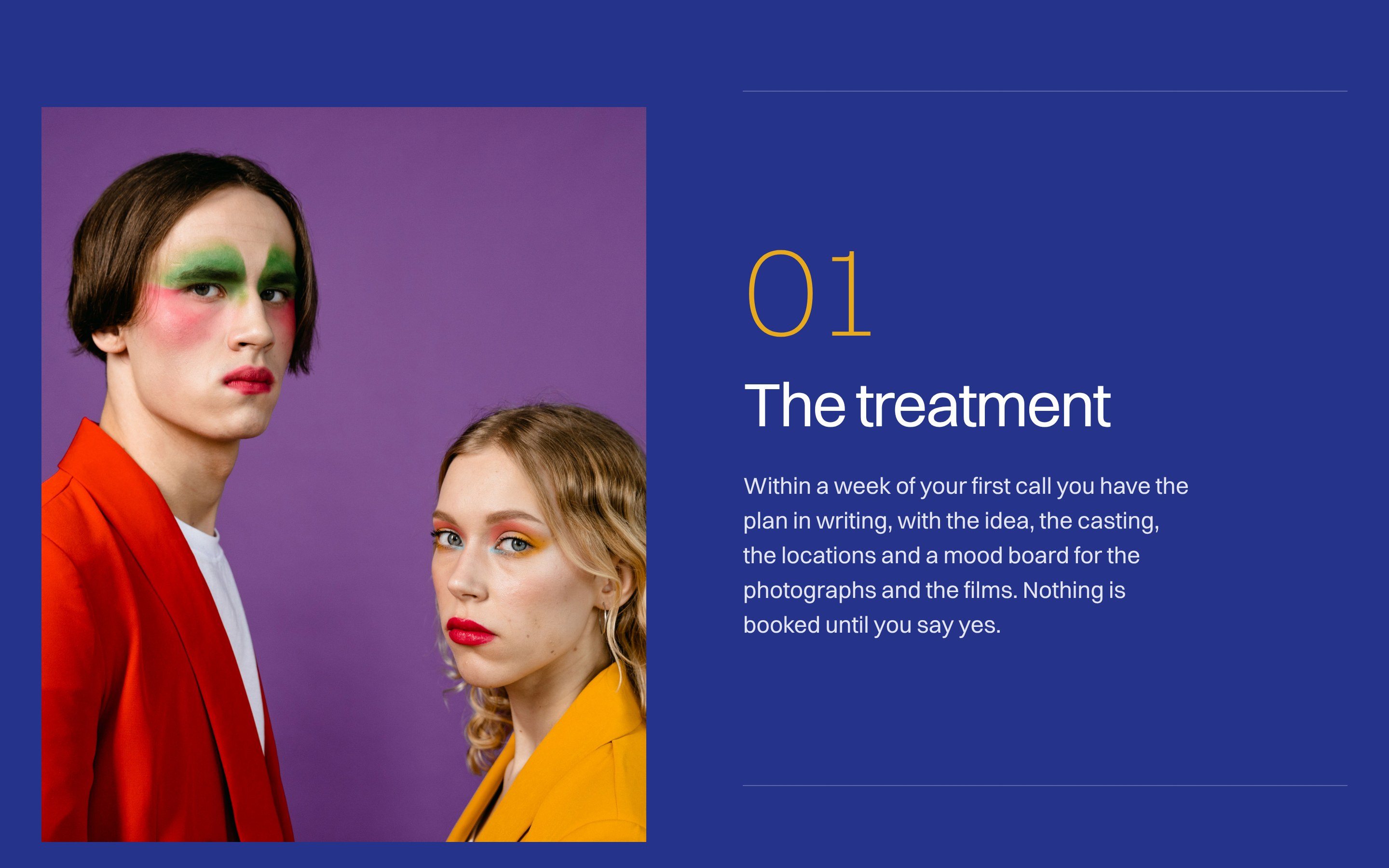
On Luz Gémea, a cobalt section called “From your first call to the final file” has four steps, and the photo beside them changes as you scroll:
- The treatment. Within a week of the first call, the brand has the plan in writing, with the idea, the casting, the locations and a mood board. “Nothing is booked until you say yes.”
- The set. The studio books the location, permits, models, stylist and crew, then sends a call sheet that shows who is arriving and when.
- The shoot. Duarte directs the photographer and the film crew together, so the films match the photographs in light and colour.
- Delivery. The first selects arrive within 48 hours. The retouched photographs and edited films follow within two weeks, sized for print and for each screen.
Under the steps, four numbers sit on the page, each with a line on what it means: 2014, the year the studio opened, 48 hours to the first selects, 31 countries photographed in and 12 campaigns a year.

Write down your real timings. If your edits take three weeks, write three weeks. A brand that knows the date can plan the launch around it.
Answer usage and price before they ask
Usage means where the brand may use your pictures, in which countries and for how long. It changes the price, so a brand’s lawyer or agency will ask about it early. In Fstoppers’ guide to licence fees, photographer Peter House writes that “Most licenses are drafted with a time limit because in reality clients do not need an image for life.”
Make it easy to ask. The Kenyan artist Thandiwe Muriu’s Info page gives one contact for her gallery and a separate one for “Commercial Bookings & Image Licensing Requests”. A brand knows where to write before she has typed a word.
On Luz Gémea, a section called “What brands ask first” answers five questions, from travel to usage rights. The usage answer says: “You agree the usage with us before the shoot, by media, country and length of time, and it goes into the contract with the quote.”
A campaign changes too much from one brand to the next for a fixed price list, so the price answer says what the price depends on: the days on location, the size of the crew and the usage. Then it asks for the brief and the launch date, and promises a treatment and a price in return. If you are unsure how much to show, my article on putting prices on your website covers the choices.

Make getting in touch one step
When she is ready, she should know exactly who to write to. Tim Walker’s contact page lists who to contact for commercial work and, separately, his gallery. Somesuch’s contact page names each person by role, from the sales teams on the East and West Coasts of the United States to the head of production.
Luz Gémea is one studio with one director, so it needs one way in. “Plan a campaign” sits in the header on every screen and opens a WhatsApp message to the studio. There is no long form. The last section, in yellow, asks for the two facts the studio needs first: “Tell us about your next collection, and when it goes on sale.”
Photographers who only want the empty studio for a day are a different visitor, so they get their own button, “Ask about a date”. It sits under the section about the 400 square metre daylight studio.

Order the page by her questions
Once you know what a brand checks, the order of the page follows. Luz Gémea is one long page, set out in the order a brand manager asks her questions:
- Three campaigns and the studio’s name, then a short note from the founder.
- The five things the studio makes, from campaign photography to behind the scenes.
- Six campaigns, then four films.
- How a shoot runs, then the numbers.
- The director’s story, then the studio to book by the day.
- Five questions brands ask, then one message to the studio.
A brand sees six campaigns and four films before she reads about a price. The Luz Gémea case study shows each section and the question it answers, and how I directed the brand and the website explains the colours, the type and the motion.
Check your art director website with this list
Open your website on a laptop and on your phone, and go through these one by one:
- Your strongest campaign is on the first screen, before any text.
- Each job is named, with the brand or the kind of client, the city and one line on what they wanted.
- Your weakest picture is gone.
- Films sit one click from the photographs, and they play on a phone.
- The page says who directs or shoots, with a few lines on what they did before.
- The steps of a shoot are written down, with real timings for the selects and the final files.
- Usage rights and what your price depends on are answered on the page.
- One clear way to get in touch, with the facts you need first, and a separate contact for each kind of visitor.
If your problem starts before the website, with how your work looks on Instagram or what you are known for, read how photographers in East Africa win bigger clients.
Short answers for photographers
What should an art director’s or photographer’s website include?
Your best campaigns first, each named with the client or kind of client and one line on what they wanted. Then films if you make them, who directs the shoot, how a shoot runs with real timings, how usage rights work and one clear way to get in touch. On Luz Gémea, all of this sits on one long page in that order.
How many photos should a photography portfolio have?
There is no fixed number. Show only work you are glad to be judged by. Photographer Jonathan Meter told Wonderful Machine that he judges a website by its worst picture. Luz Gémea shows six campaigns, each with one large photograph and two lines on what the brand wanted.
Should a photographer put prices on the website?
A campaign changes too much from one brand to the next for a fixed price list, but you can say what your price depends on. On Luz Gémea, the answer names the days on location, the size of the crew and the usage, then asks for the brief and the launch date. My article on prices on your website covers the other choices.
Is Instagram enough for a photographer?
Instagram is good for being found, but you do not control who sees your posts, and it has no room for your process, timings or usage terms. A website holds all of that in one place and stays yours. I cover this in how photographers in East Africa win bigger clients.
How long does it take to build a photographer’s website?
A website of up to 5 pages usually takes about a week, and bigger websites take longer. The time starts once your notes, logo, photos and the deposit are in. You can see the packages on the services page.