
You lead a church in Dar es Salaam, Arusha, Nairobi or Kampala. Your members hear the news on Sunday and in the church WhatsApp group. The people who have never been, such as a student new to the city, a family who has just moved or a colleague a member invited, look you up on a phone first.
What they find there helps them decide whether to come on Sunday. If the service times are missing, or the page takes too long to open on mobile data, it is easy to give up and stay at home.
This article is a checklist for a church website in Africa, with Tanzania and Kenya as the main examples and the facts behind each point: how people here go online, how they pay and what a visitor needs to know before a first Sunday. The examples come from churches in Nairobi and Dar es Salaam, including the Ocean Church redesign I proposed.
Design for a phone on mobile data
In October 2026, 69% of the web pages viewed in Tanzania were viewed on a mobile phone, according to StatCounter. Across Africa the figure was 68%, and in Kenya 52%. StatCounter counts page views on the websites that use its tracking code, so treat these numbers as a guide to how people browse.
Tanzania’s regulator, the TCRA, counted 31.34 million smartphones in the country in June 2026, as reported by TanzaniaInvest.
Google reads the phone version of your website too. Its Search documentation says Google uses the mobile version of a site’s content for indexing and ranking. If your service times are hidden on the phone layout, Google may miss them as well.
So plan the phone layout first. Open every page on a real phone, scroll it with your thumb, and only then look at it on a laptop.
Speed counts too. A visitor on a data bundle pays for every photo your home page loads, and waits for it too. Google’s guide to Largest Contentful Paint on web.dev says the biggest thing on the first screen should appear within 2.5 seconds for a good experience. Google Search Central also recommends that site owners reach good Core Web Vitals, the set of speed and stability measures this belongs to.
Photos and video are usually the heaviest files on a church website, so start there:
- Resize each photo to the size it shows on the screen, and save it in a modern format such as WebP.
- Load a sermon video only when the visitor presses play.
- Use one or two fonts, and load only the weights you use.
- Test the site on a mid-range phone on mobile data, away from the office Wi-Fi.
Service times on the first screen
The first thing a visitor looks for is the day, the time and the place. Nairobi Chapel puts them all on its home page: Sunday services at 9:00am and 11:30am, children and teens at the same times, young adults at 11:30am, and the address on Jamhuri Road, off Ngong Road.
If you hold services in more than one language, put the language beside each time. If a time changes for a holiday, change it on the website the same day.
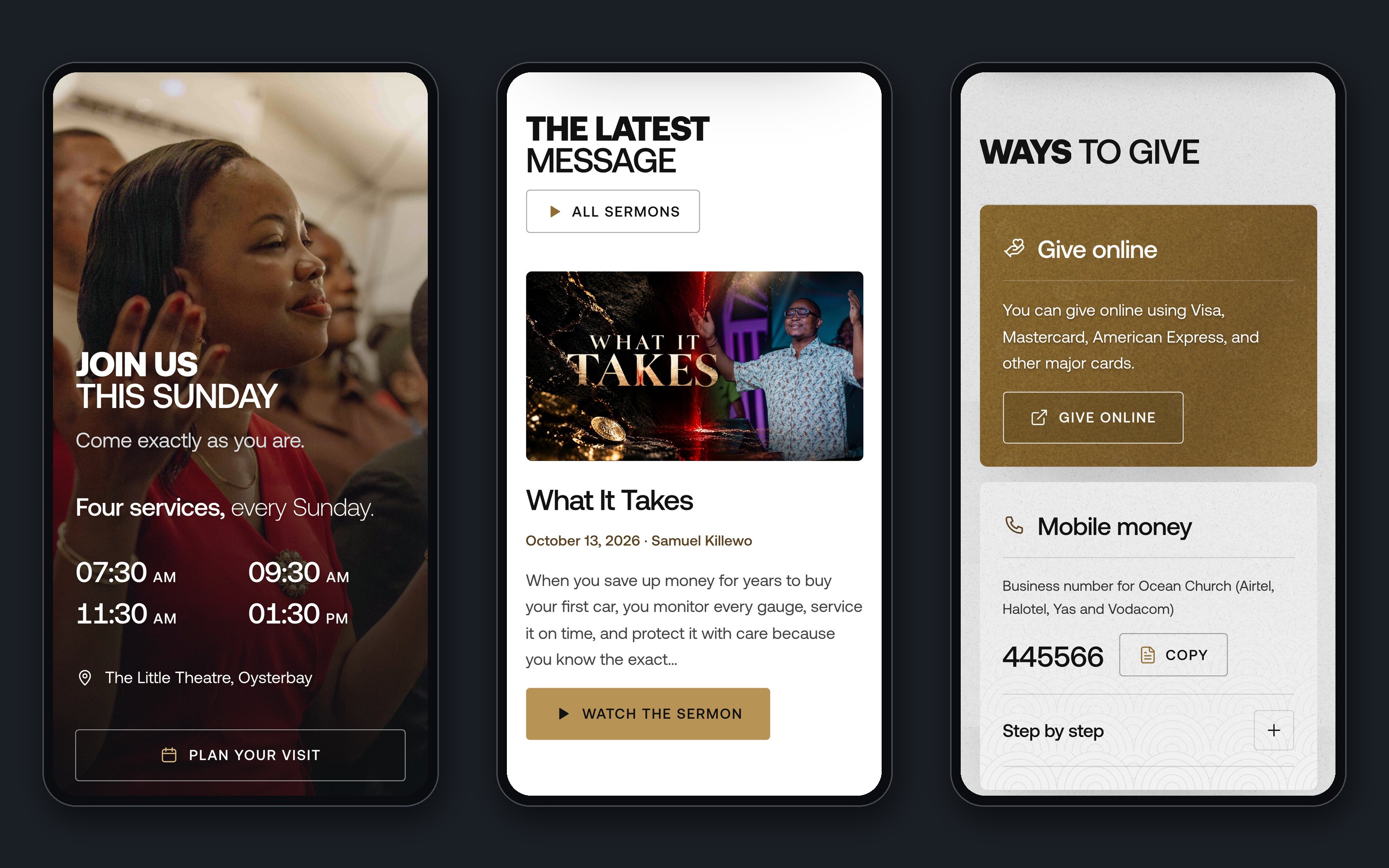
Type the times in one place only. In the Ocean Church redesign, the times, the address and the children’s ages live in one set of fields, and every page reads them from there. The first screen on a phone ends with “Every Sunday” and the Little Theatre in Oysterbay, and the menu shows all four service times with a Directions button.

Location, parking and getting there
A visitor needs more than the name of the road. Tell them how to arrive, where to park and which door to use.
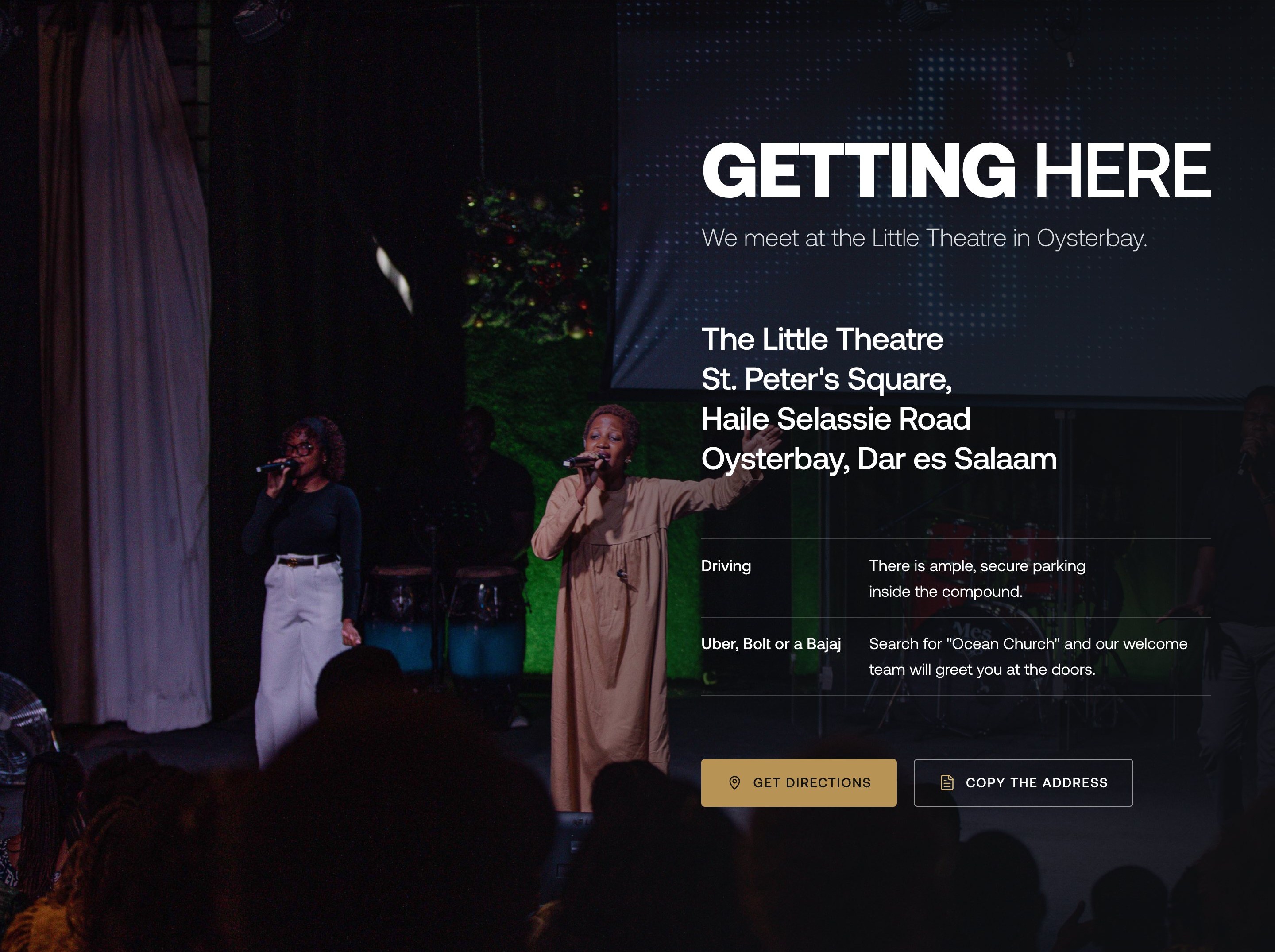
Ocean Church’s current Plan your visit page does this well. It names the theatre, the square and the road, says there is secure parking inside the compound, and tells visitors who use Uber, Bolt or a Bajaj to search for “Ocean Church” in the app. The redesign keeps all of this and adds a Copy the address button, so a visitor can paste the address into a message to a driver.
On your own site, add:
- A map link that opens in Google Maps on the phone.
- A landmark near the gate that a driver will know.
- Where to park, and what to do if the parking is full.
- Which door to use, and who will meet them there.
- A WhatsApp number for anyone who is lost on the way.
What to expect, and the children
A first visit is easier when the visitor knows what will happen. Say how long the service lasts, what language it is in, what people wear and what happens with the children.
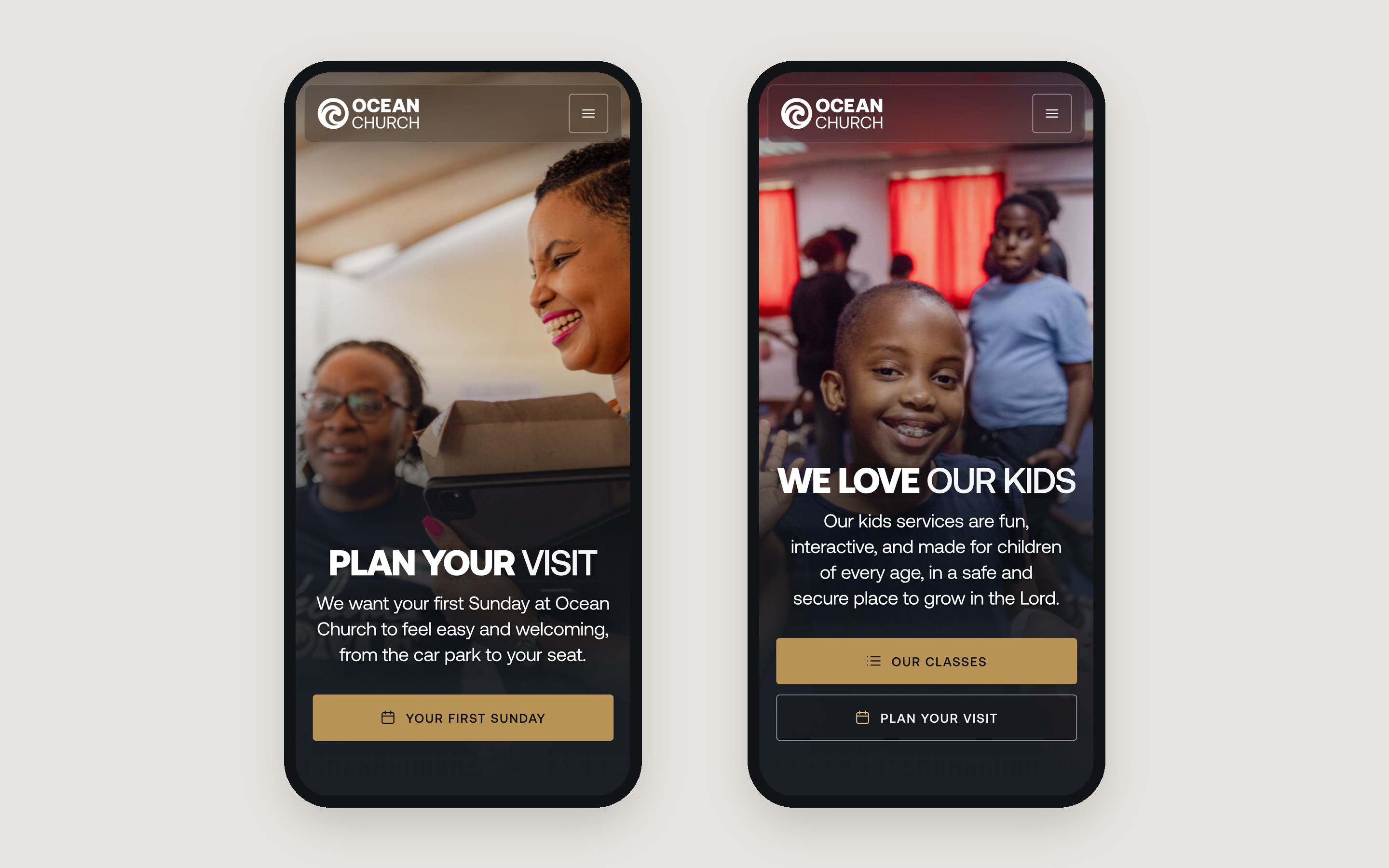
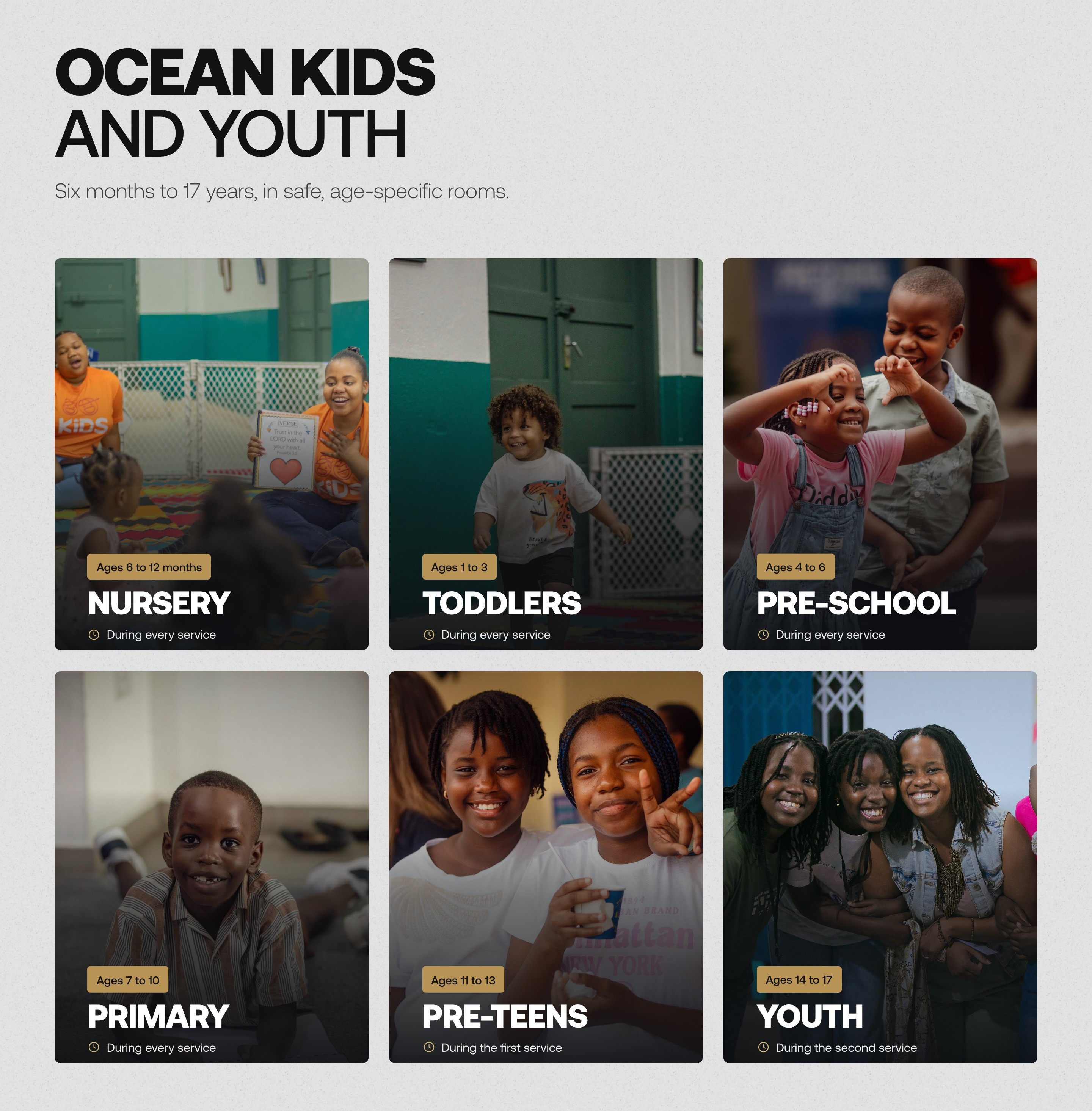
CITAM’s I’m New Here page in Nairobi opens with a welcome letter from the Presiding Bishop, then points visitors to the service times and the church’s frequently asked questions. Ocean Church lists its children’s classes by age, from a nursery for babies of six months to pre-teens of 13, and tells parents to look for the “Ocean Kids” sign in the lobby to check their child in.
For the children, give the age groups, where to check in, who looks after them and how parents collect them.
Sermons to watch or to read
A sermon online lets a visitor hear your pastor before they come. On a phone with a small data bundle, a long video can be too much, so offer the same message in lighter forms as well: the audio, the notes or a short clip.
Mavuno Church in Nairobi has a “Watch The Sunday Sermon” section on its home page. In the Ocean Church redesign, each sermon has its own page, with the video at the top and the written notes underneath, and the sermons page groups every message by series and topic with a search.

Giving by mobile money
TCRA counted 87.05 million mobile money accounts in Tanzania in June 2026, as reported by TanzaniaInvest. One person can hold more than one account, but the number shows how widely mobile money is used.
Church websites in the region already show this. Ocean Church’s Give page lists bank transfer, Selcom, a mobile money till for Airtel, Halotel, Yas and Vodacom, and cards online. Nairobi Chapel shows its M-Pesa Paybill number and bank details on its home page, and asks givers to put the reason for giving in the account field. On CITAM’s website, the Give menu has a Paybill Number page next to Online Giving.

On your Give page:
- Show each till, Paybill and account number as text a person can copy.
- Say which name will appear on the phone when they pay.
- Say what to write in the reference or account field for tithes, offerings or a building fund.
- Add a card option for members and friends who give from abroad.
Events, languages and WhatsApp
List what is coming up with a date, a time and a place, and take each event down when it is over.
If your church worships in Swahili and English, say which service is in which language, and think about the website in both. Mavuno’s menu uses Swahili names for some of its groups, such as Mizizi, Ndoa and Simama. If your English service welcomes people who are new to the city, reaching English speakers in Dar es Salaam has more on what they look for.
Nairobi Chapel lists a WhatsApp number on its home page, next to its phone number. A WhatsApp link that opens a chat with the church office gives a visitor a simple way to ask a question before Sunday.
Checklist for a church website in Africa
Take your phone, switch off Wi-Fi and open your church website. Then check:
- The day, the times and the place are on the first screen.
- Each time says which language the service is in, if you have more than one.
- The address opens in Google Maps, with a landmark, parking and the door to use.
- One page explains a first visit: length, language, dress and what happens.
- The children’s groups have age ranges and a check-in point.
- The first screen loads within about 2.5 seconds on mobile data.
- The latest sermon is one tap away, with audio or notes for small data bundles.
- The Give page shows mobile money numbers as text, with the account name.
- Past events are gone from the home page and the menu.
- A WhatsApp link opens a chat with the church office.
- When a service time changes, one edit updates every page that shows it.
For examples from churches in the UK, the US and Australia, read what the best church websites get right.
Short answers for churches in Africa
What should a church website include?
The service times and the place on the first screen, a Plan your visit page, the children’s groups by age, the latest sermon, events with dates, a Give page with mobile money details and a WhatsApp link to the office. Everything should work well on a phone on mobile data.
How much web browsing in Tanzania happens on phones?
StatCounter shows that 69% of web page views in Tanzania in October 2026 were on mobile phones, 30% on desktop computers and under 1% on tablets. It measures page views on the websites that use StatCounter, so treat it as a guide.
Can people give to a church through its website with mobile money?
Yes. The simplest way is to show your till or Paybill number and the account name as text on the Give page, with what to write in the reference field. Ocean Church’s Give page lists a mobile money till for Airtel, Halotel, Yas and Vodacom, alongside bank transfer, Selcom and cards.
Should a church website in Tanzania be in Swahili or English?
Write it in the language your services are held in, and in both if you hold services in both. If you have an English service for international members, make sure the times, the address and the Plan your visit page are in English.
How fast should a church website load on a phone?
Google’s guide on web.dev says the largest thing on the first screen should appear within 2.5 seconds for a good experience. Resized photos, a video that loads only when someone presses play and fewer fonts are the first things to check.

