
Your best projects are on Instagram, the website still leads with a kitchen you finished four years ago, and the enquiries that come through ask for a quick colour scheme when you take on whole homes. You know the site is selling the wrong version of your practice.
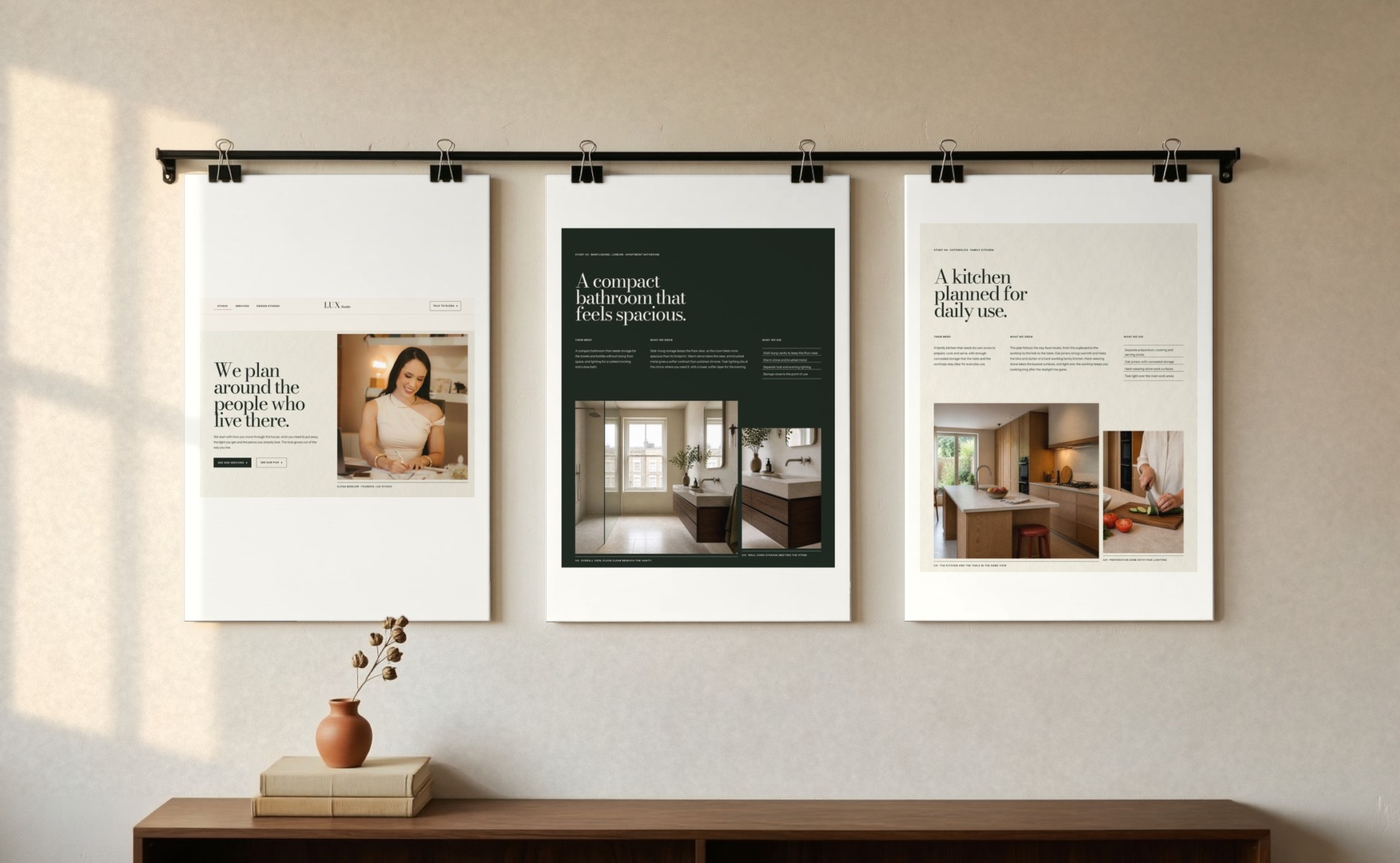
What should an interior design portfolio website show? Fewer projects than you have, each told from the brief to the finished room, and each ending with a way to write to you. I will use LUX Studio, a five-page website I designed for a private interior design studio in Marylebone, where the portfolio is called Design Studies.
How many projects should your portfolio show?
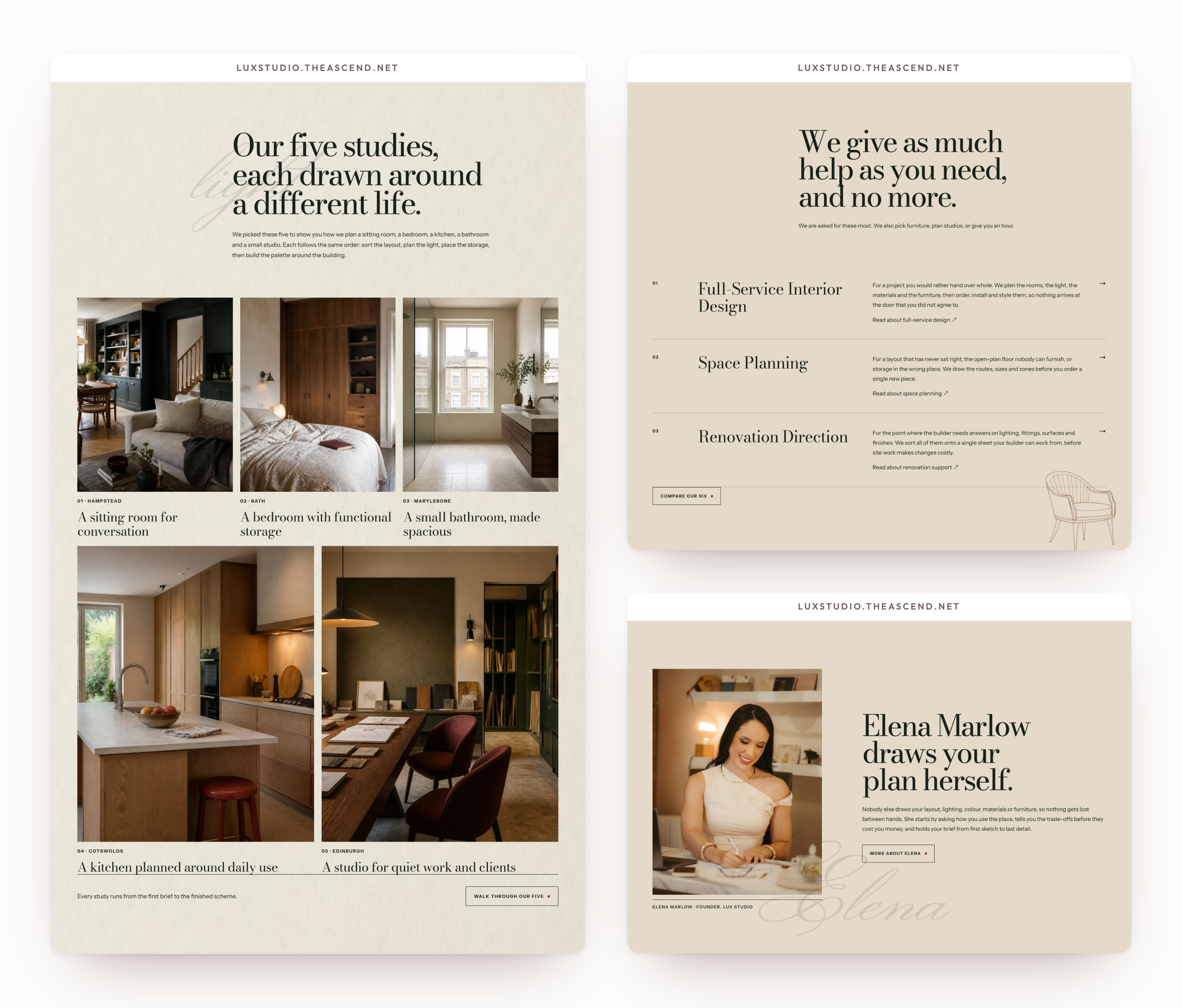
Portfolio guides commonly suggest five to ten, and prefer a small set of strong projects to a long grid. LUX shows five, chosen so that each covers a different kind of room: a sitting room in Hampstead, a bedroom in Bath, a small bathroom in Marylebone, a kitchen in the Cotswolds and a studio in Edinburgh. The heading over them says why they were picked: “Our five studies, each drawn around a different life.”
Choose the projects that look like the work you want more of. If whole homes are what you want, lead with a whole home, even when a single room has the grander photographs. An older project can stay if it still shows how you plan. A kitchen that only shows a nice finish can go.
What does a homeowner need beyond the photographs?
To see how you think. A whole-home commission is a large investment, and often a first. A homeowner looking at finished rooms can see your taste and still can’t tell how you would plan their house, what the work involves or which decisions they will be asked to make.
The LUX home page names that moment in the homeowner’s own scene: “Twelve samples are on the table and none of them agree with the light. The electrician wants the lighting plan by Friday and nobody has decided where the bed goes.” Behind it sits the fear of buying twice, a sofa that does not fit the wall or a builder waiting on a finish. A portfolio that shows the planning answers that fear before the first call.
How should each project be written up?
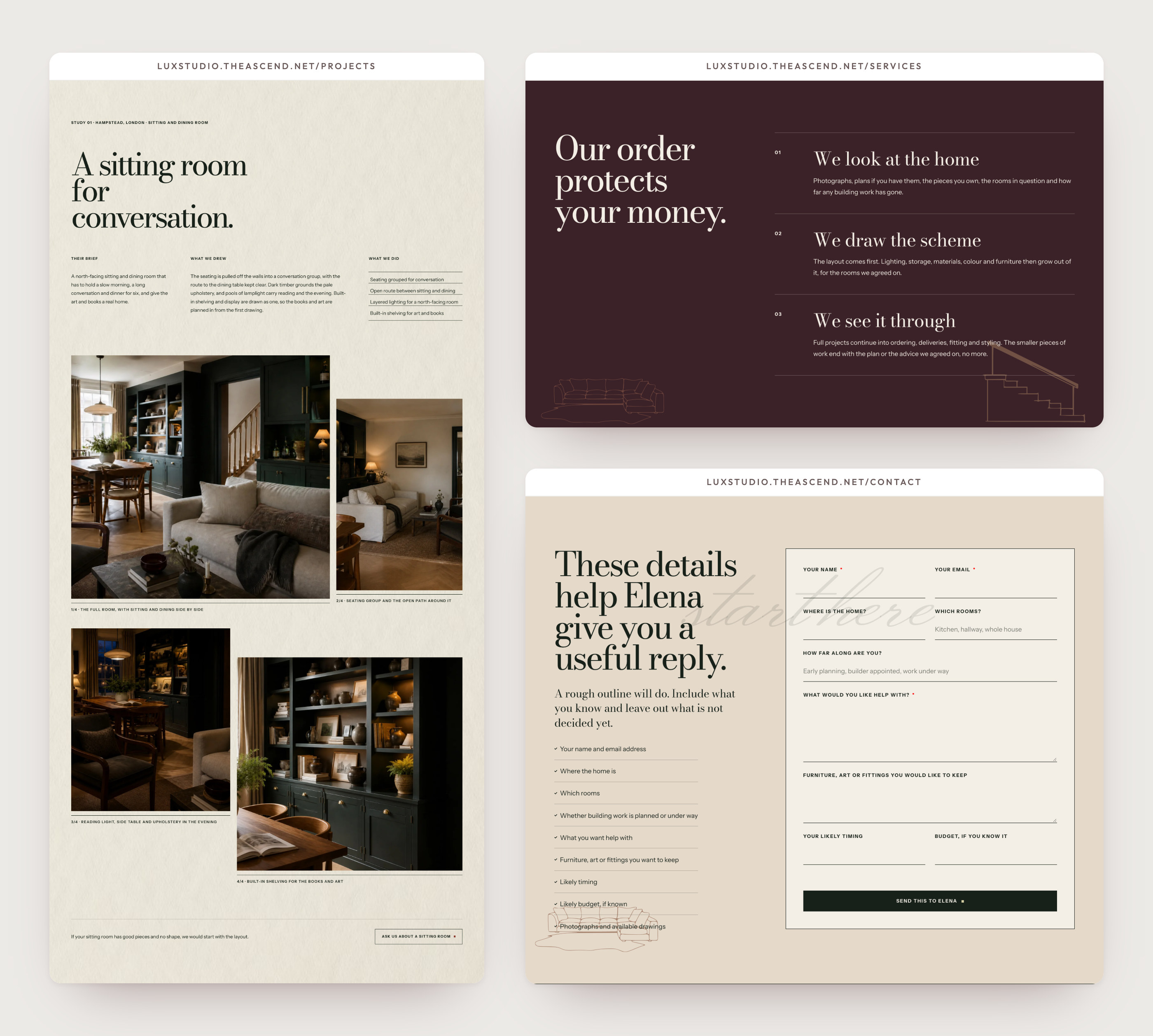
As a short case study, in the same order every time. Each LUX study has three parts: the client’s brief, what was drawn and what was done. The reader sees the thinking before the result, and the thinking is what they can’t judge from a photograph.
Title each study by what it solved, in the words designers use with clients: “A sitting room for conversation”, “A bedroom with functional storage”, “A small bathroom, made spacious”, “A kitchen planned around daily use”. A homeowner with a cramped bathroom finds theirs among the titles before opening a page.
Captions explain what a photograph can’t. LUX sets them in small capitals beside each detail, such as “Task and ambient lighting layers” and “Materials sampled in your own daylight”. On your own studies, a caption can say why the bed sits on that wall, what the joinery is made of or which lights are on separate circuits.
Which photograph should open a project?
The one that shows the layout. Each LUX study opens wide on the room, then moves in close on the joinery, the stone and the light, because the layout is what a homeowner is paying you to work out. Some portfolio advice opens on a detail to set the mood; for a practice that sells space planning, the wide view earns the first place.
If you have them, show the plan and a before photograph beside the finished room. A drawing shows the thinking, and a well-chosen before shows the size of the change. Keep each caption under the photograph it describes, so the order holds on a phone.
Where do your clients’ words belong?
Close to the work they describe, signed with a name and a place. On LUX, each review carries the client’s name and the town, such as Andrea Henry in Hampstead, which a reader can match to the Hampstead sitting room: “Elena saw the problem on our first call.”
Ask each client before you publish their words, and agree the name and place they are happy to show. Never write or tidy a quote on a client’s behalf.
How does a project lead to an enquiry?
Every page of studies should end with a way to write. On LUX, Home, Studio, Services and Design Studies each close on a terracotta panel with a question, such as “So, what is not working at home?”, and a link to Elena.
The contact page then asks for what helps her reply well: where the home is, which rooms, how far along the work is, what help is wanted, the pieces to keep, likely timing and a budget if known, with photographs welcome. It also says what the reader doesn’t need yet: “You do not need drawings or decisions yet.” Elena replies with where she would begin, and why.
A homeowner who has just read a study of a bathroom like theirs is ready to write at that moment, so the link belongs on the study itself.

What a portfolio website like LUX involves
LUX is a five-page website: Home, Studio, Services, Design Studies and Contact. The five-page launch takes up to 30 sections, copy of up to 4,500 words and up to 40 chosen images, built over five booked working days from $1,350. A project with its own layout and a large set of photographs can be added as a project page from $275, and Elena adds new studies herself in the editor. The Services page lists every launch, and what to prepare before a website project covers the photography to book first.

What interior designers ask about portfolios
How many projects should an interior design portfolio show?
Five to ten is the range portfolio guides give, each told in full. LUX shows five, each a different kind of room.
Should I show before and after photos?
If you have them. A single before photograph beside the finished room shows the size of the change, and the plan beside it shows how you got there.
Do I need professional photography for my portfolio?
For the projects that lead, yes. Photographs are the first proof a homeowner judges. Book the shoot before the website, because the layout is designed around the pictures.
Should my portfolio show prices?
LUX shows no figures. It does show the smallest way to work with Elena, an hour-long Focused Design Session, so a homeowner with a single question knows there is a way in. Whether to publish figures is weighed in should you put prices on your website.
Can I add new projects to my website myself?
Yes. On LUX, Elena adds a new study in the editor, and the page keeps its order and layout.